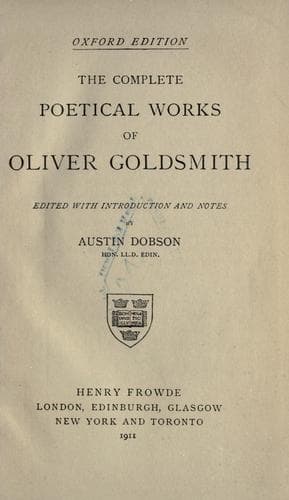
The Complete Poetical Works of Oliver GoldsmithGoldsmith, Oliver
General
The Complete Poetical Works of Oliver Goldsmith
Goldsmith, Oliver
English poetry; Literature -- Collections
Now breaking a jest, and now breaking a limb. A
note to the second edition says—‘The above Gentleman [Richard Burke,
_v. supra_] having slightly fractured one of his arms and legs, at
different times, the Doctor [i.e. Goldsmith] has rallied him on those
accidents, as a kind of _retributive_ justice for breaking his jests
on other people.’
Here Cumberland lies. According to Boaden’s _Life
of Kemble_, 1825, i. 438, Mrs. Piozzi rightly regarded this portrait
as wholly ironical; and Bolton Corney, without much expenditure of acumen,
discovers it to have been written in a spirit of _persiflage_.
Nevertheless, Cumberland himself (_Memoirs_, 1807, i. 369)
seems to have accepted it in good faith. Speaking of Goldsmith he says—I
conclude my account of him with gratitude for the epitaph he bestowed on
me in his poem called _ Retaliation_.’ From the further details
which he gives of the circumstances, it would appear that his own
performance, of which he could recall but one line—
All mourn the poet, I lament the man—
was conceived in a less malicious spirit than those of the others, and had
predisposed the sensitive bard in his favour. But no very genuine
cordiality could be expected to exist between the rival authors of _The
West Indian_ and _She Stoops to Conquer_.
And Comedy wonders at being so fine. It is
instructive
here to transcribe Goldsmith’s serious opinion of the kind of work which
Cumberland essayed:—‘A new species of Dramatic Composition has been
introduced, under the name of _ Sentimental_ Comedy, in which the
virtues of Private Life are exhibited, rather than the Vices exposed; and
the Distresses rather than the Faults of Mankind, make our interest in the
piece. . . . In these Plays almost all the Characters are good, and
exceedingly generous; they are lavish enough of their _Tin_ Money on
the Stage, and though they want Humour, have abundance of Sentiment and
Feeling. If they happen to have Faults or Foibles, the Spectator is taught
not only to pardon, but to applaud them, in consideration of the goodness
of their hearts; so that Folly, instead of being ridiculed, is commended,
and the Comedy aims at touching our Passions without the power of being
truly pathetic.’ (_Westminster Magazine_, 1772, i. 5.) Cf. also
the _Preface to The Good Natur’d Man_, where he ‘hopes that too
much refinement will not banish humour and character from our’s, as it has
already done from the French theatre. Indeed the French comedy is now
become so very elevated and sentimental, that it has not only banished
humour and _Moliere_ from the stage, but it has banished all
spectators too.’
Public-domain text, read in full here on John Shaqi.
Reviews
Reviews
No reviews yet
Be the first to share your thoughts on this work.
Elsewhere in the archive
Join the Discussion
Join the discussion
Sign in to leave a comment or review.
Sign InorCreate an account