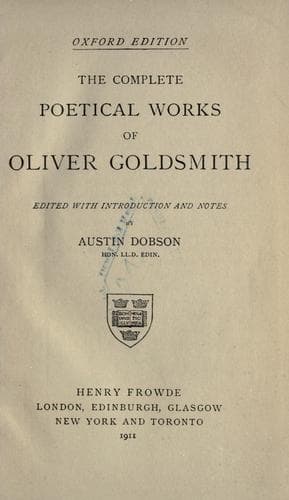
The Complete Poetical Works of Oliver GoldsmithGoldsmith, Oliver
General
The Complete Poetical Works of Oliver Goldsmith
Goldsmith, Oliver
English poetry; Literature -- Collections
These lines, which appear at p. 312 of vol. V of the _History of the
Earth and Animated Nature_, 1774, are freely translated from some
Latin verses by Addison in No 412 of the _Spectator_, where
they are introduced as follows:—‘Thus we see that every different
Species of sensible Creatures has its different Notions of Beauty, and
that each of them is most affected with the Beauties of its own kind. This
is nowhere more remarkable than in Birds of the same Shape and Proportion,
where we often see the Male determined in his Courtship by the single
Grain or Tincture of a Feather, and never discovering any Charms but in
the Colour of its own Species.’ Addison’s lines, of which Goldsmith
translated the first fourteen only, are printed from his corrected MS. at
p. 4 of _Some Portions of Essays contributed to the Spectator by Mr.
Joseph Addison_ [by the late J. Dykes Campbell], 1864.
THE HAUNCH OF VENISON.
It is supposed that this poem was written early in 1771, although it was
not printed until 1776, when it was published by G. Kearsly and J. Ridley
under the title of _The Haunch of Venison, a Poetical Epistle to the
Lord Clare. By the late Dr. Goldsmith. With a Head of the Author, Drawn by
Henry Bunbury, Esq; and Etched by_ [_James_] _ Bretherton._
A second edition, the text of which is here followed, appeared in the same
year ‘With considerable Additions and Corrections, Taken from the Author’s
_last_ Transcript.’ The Lord Clare to whom the verses are addressed
was Robert Nugent, of Carlanstown, Westmeath, M.P. for St. Mawes in
1741–54. In 1766 he was created Viscount Clare; in 1776 Earl Nugent. In
his youth he had himself been an easy if not very original versifier; and
there are several of his performances in the second volume of Dodsley’s
_Collection of Poems by Several Hands_, 4th ed., 1755. One of
the Epistles, beginning ‘Clarinda, dearly lov’d, attend The Counsels of a
faithful friend,’ seems to have betrayed Goldsmith into the blunder of
confusing it, in the _Poems for Young Ladies_. 1767, p. 114,
with Lyttelton’s better-known _ Advice to a Lady_ (‘The
counsels of
a friend, Belinda, hear’), also in Dodsley’s miscellany; while another
piece, an _Ode to William Pultney, Esq._, contains a stanza so
good that Gibbon worked it into his character of Brutus:—
What tho’ the good, the brave, the wise,
With adverse force undaunted rise,
To break th’ eternal doom!
Tho’ CATO liv’d, tho’ TULLY spoke,
Tho’ BRUTUS dealt the godlike stroke,
Yet perish’d fated ROME.
Public-domain text, read in full here on John Shaqi.
Reviews
Reviews
No reviews yet
Be the first to share your thoughts on this work.
Elsewhere in the archive
Join the Discussion
Join the discussion
Sign in to leave a comment or review.
Sign InorCreate an account