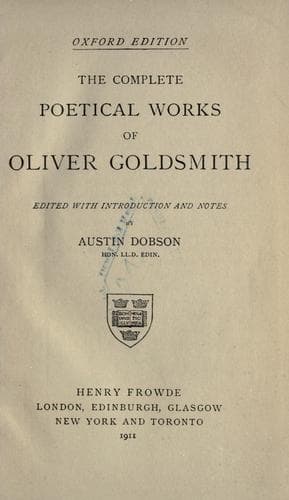
The Complete Poetical Works of Oliver GoldsmithGoldsmith, Oliver
General
The Complete Poetical Works of Oliver Goldsmith
Goldsmith, Oliver
English poetry; Literature -- Collections
Detraction, however, has insinuated that Mallet, his step-son’s tutor, was
Nugent’s penholder in this instance. ‘Mr. Nugent sure did not write his
own Ode,’ says Gray to Walpole (Gray’s _Works_, by Gosse, 1884,
ii. 220). Earl Nugent died in Dublin in October, 1788, and was buried at
Gosfield in Essex, a property he had acquired with his second wife. A _
Memoir_ of him was written in 1898 by Mr. Claud Nugent. He is described
by Cunningham as ‘a big, jovial, voluptuous Irishman, with a loud voice, a
strong Irish accent, and a ready though coarse wit.’ According to Percy (_Memoir_,
1801, p. 66), he had been attracted to Goldsmith by the publication of
_The Traveller_ in 1764, and he mentioned him favourably to the
Earl of Northumberland, then Lord Lieutenant of Ireland. A note in
Forster’s _Life_, 1871, ii. 329–30, speaks of Goldsmith as a
frequent visitor at Gosfield, and at Nugent’s house in Great George
Street, Westminster, where he had often for playmate his host’s daughter,
Mary, afterwards Marchioness of Buckingham.
Scott and others regarded _The Haunch of Venison_ as
autobiographical. To what extent this is the case, it is difficult to say.
That it represents the actual thanks of the poet to Lord Clare for an
actual present of venison, part of which he promptly transferred to
Reynolds, is probably the fact. But, as the following notes show, it is
also clear that Goldsmith borrowed, if not his entire fable, at least some
of its details from Boileau’s third satire; and that, in certain of the
lines, he had in memory Swift’s _Grand Question Debated_, the
measure of which he adopts. This throws more than a doubt upon the truth
of the whole. ‘His genius’ (as Hazlitt says) ‘was a mixture of originality
and imitation’; and fact and fiction often mingle inseparably
in his work. The author of the bailiff scene in the _Good Natur’d Man_
was quite capable of inventing for the nonce the tragedy of the unbaked
pasty, or of selecting from the Pilkingtons and Purdons of his
acquaintance such appropriate guests for his Mile End Amphitryon as the
writers of the _Snarler_ and the _Scourge_. It may
indeed even be doubted whether, if _The Haunch of Venison_ had
been absolute personal history, Goldsmith would ever have retailed it to
his noble patron at Gosfield, although it may include enough of real
experience to serve as the basis for a _jeu d’esprit_.
The fat was so white, etc. The first version reads—‘The
white was so white, and the red was so ruddy.’
Though my stomach was sharp, etc. This couplet is
not in the first version.
Public-domain text, read in full here on John Shaqi.
Reviews
Reviews
No reviews yet
Be the first to share your thoughts on this work.
Elsewhere in the archive
Join the Discussion
Join the discussion
Sign in to leave a comment or review.
Sign InorCreate an account