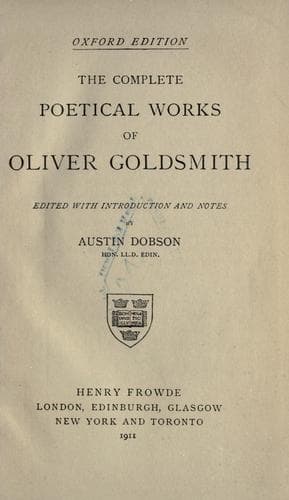
The Complete Poetical Works of Oliver GoldsmithGoldsmith, Oliver
General
The Complete Poetical Works of Oliver Goldsmith
Goldsmith, Oliver
English poetry; Literature -- Collections
Some think he writes Cinna—he owns to Panurge.
‘Panurge’ and ‘Cinna’ are signatures which were frequently to be found at
the foot of letters addressed to the _Public Advertiser_ in
1770–1 in support of Lord Sandwich and the Government. They are said to
have been written by Dr. W. Scott, Vicar of Simonburn, Northumberland, and
chaplain of Greenwich Hospital, both of which preferments had been given
him by Sandwich. In 1765 he had attacked Lord Bute and his policy over the
signature of ‘Anti-Sejanus.’ ‘Sandwich and his parson Anti-Sejanus [are]
hooted off the stage’—writes Walpole to Mann, March 21, 1766.
According to Prior, it was Scott who visited Goldsmith in his Temple
chambers, and invited him to ‘draw a venal quill’ for Lord North’s
administration. Goldsmith’s noble answer, as reported by his reverend
friend, was—‘I can earn as much as will supply my wants without
writing for any party; the assistance therefore you offer is unnecessary
to me.’ (_Life_, 1837, ii. 278.) There is a caricature portrait
of Scott at p. 141 of _The London Museum_ for February, 1771,
entitled ‘Twitcher’s Advocate,’ ‘Jemmy Twitcher’ being the nickname of
Lord Sandwich.
Swinging, great, huge. ‘Bishop Lowth has just
finished the Dramas, and sent me word, that although I have paid him the
most _swinging_ compliment he ever received, he likes the whole book
more than he can say.’ (_Memoirs of Hannah More_, 1834, i.
236.)
pasty. The first version has Ven’son.’
So there I sat, etc. This couplet is not in the
first version.
And, ‘Madam,’ quoth he. Mr. Lobban again quotes
Swift’s _Grand Question Debated_:—
And ‘Madam,’ says he, ‘if such dinners you give
You’ll ne’er want for parsons as long as you live.’
These slight resemblances, coupled with the more obvious likeness of the
‘Raphaels, Correggios, and stuff’ of _ Retaliation_ (ll. 145–6)
to the _Noueds_ and _ Bluturks_ and _Omurs_ and stuff’
(also pointed out by Mr. Lobban) are interesting, because they show
plainly that Goldsmith remembered the works of Swift far better than _The
New Bath Guide_, which has sometimes been supposed to have set the
tune to the _Haunch_ and _Retaliation_.
‘may this bit be my poison.’ The gentleman in _She
Stoops to Conquer_, Act i, who is ‘obligated to dance a bear.’ Uses
the same asseveration. Cf. also Squire Thornhill’s somewhat similar
formula in chap. vii of _The Vicar of Wakefield_, 1766, i. 59.
‘The tripe,’ quoth the Jew, etc. The first version
reads—
‘Your Tripe!’ quoth the _Jew_, ‘if the truth I may speak,
I could eat of this Tripe seven days in the week.’
Re-echoed, i.e. ‘returned’ in the first edition.
Public-domain text, read in full here on John Shaqi.
Reviews
Reviews
No reviews yet
Be the first to share your thoughts on this work.
Elsewhere in the archive
Join the Discussion
Join the discussion
Sign in to leave a comment or review.
Sign InorCreate an account