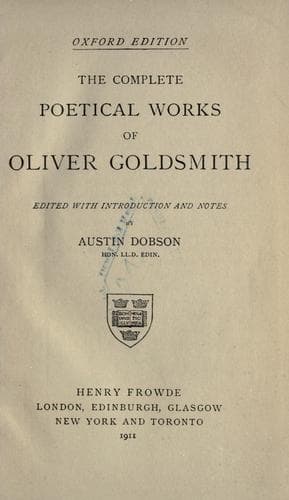
The Complete Poetical Works of Oliver GoldsmithGoldsmith, Oliver
General
The Complete Poetical Works of Oliver Goldsmith
Goldsmith, Oliver
English poetry; Literature -- Collections
thot. This, probably by a printer’s error, is
altered to ‘that’ in the second version. But the first reading is the more
in keeping, besides being a better rhyme.
Wak’d Priam. Cf. 2 _Henry IV_, Act I,
Sc. 1:—
Even such a man, so faint, so spiritless,
So dull, so dead in look, so woe-begone,
Drew Priam’s curtain in the dead of night.
And would have told him half his Troy was burnt.
sicken’d over by learning. Cf. _Hamlet_,
Act iii, Sc. 1:
And thus the native hue of resolution
Is _sicklied o’er_ with the pale cast of thought.
Notwithstanding the condemnation of Shakespeare in the _Present State
of Polite Learning_, and elsewhere, Goldsmith frequently weaves
Shakespearean recollections into his work. Cf. _She Stoops to Conquer_,
1773, Act i, p. 13, ‘We wanted no ghost to tell us that’ (_Hamlet_,
Act i, Sc. 5); and Act i, p. 9, where he uses Falstaff’s words (1 _Henry
IV_, Act v, Sc. 1):—
Would it were bed-time and all were well.
as very well known. The first version has, ‘’tis
very well known.’
EPITAPH ON THOMAS PARNELL.
This epitaph, apparently never used, was published with _The Haunch
of Venison_, 1776; and is supposed to have been written about 1770.
In that year Goldsmith wrote a _Life of Thomas Parnell, D.D._,
to accompany an edition of his poems, printed for Davies of Russell
Street. Parnell was born in 1679, and died at Chester in 1718, on his way
to Ireland. He was buried at Trinity Church in that town, on the 24th of
October. Goldsmith says that his father and uncle both knew Parnell (_Life
of Parnell_, 1770, p. v), and that he received assistance from the
poet’s nephew, Sir John Parnell, the singing gentleman who figures in
Hogarth’s _Election Entertainment_. Why Goldsmith should write
an epitaph upon a man who died ten years before his own birth, is not easy
to explain. But Johnson also wrote a Latin one, which he gave to Boswell.
(Birkbeck Hill’s _Life_, 1887, iv. 54.)
gentle Parnell’s name. Mitford compares Pope on
Parnell [_Epistle to Harley_, l. iv]:—
With softest manners, gentlest Arts adorn’d.
Pope published Parnell’s _Poems_ in 1722, and his sending them
to Harley, Earl of Oxford, after the latter’s disgrace and retirement, was
the occasion of the foregoing epistle, from which the following lines
respecting Parnell may also be cited:—
For him, thou oft hast bid the World attend,
Fond to forget the statesman in the friend;
For SWIFT and him despis’d the farce of state,
The sober follies of the wise and great;
Dext’rous the craving, fawning crowd to quit,
And pleas’d to ’scape from Flattery to Wit.
Public-domain text, read in full here on John Shaqi.
Reviews
Reviews
No reviews yet
Be the first to share your thoughts on this work.
Elsewhere in the archive
Join the Discussion
Join the discussion
Sign in to leave a comment or review.
Sign InorCreate an account