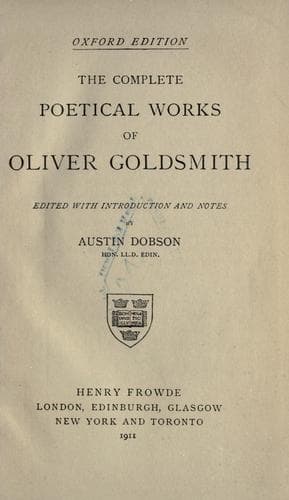
The Complete Poetical Works of Oliver GoldsmithGoldsmith, Oliver
General
The Complete Poetical Works of Oliver Goldsmith
Goldsmith, Oliver
English poetry; Literature -- Collections
According to Prior (_Miscellaneous Works_, 1837, iv. 154),
Goldsmith’s friend, Dr. Farr, had a copy of this epilogue which still,
when Prior wrote, remained in that gentleman’s family.
Who mump their passion, i.e. grimace their
passion.
ye macaroni train. The Macaronies were the
foplings, fribbles, or beaux of Goldsmith’s day. Walpole refers to them as
early as 1764; but their flourishing time was 1770–3, when the
print-shops, and especially Matthew Darly’s in the Strand, No. 39, swarmed
with satirical designs of which they were the subject. Selwyn, March—many
well-known names—are found in their ranks. Richard Cosway figured as
‘The Macaroni Painter’; Angelica Kauffmann as ‘The Paintress of
Maccaroni’s’; Thrale as ‘The Southwark Macaroni.’ Another caricature (‘The
Fluttering Macaroni’) contains a portrait of Miss Catley, the singing
actress of the present epilogue; while Charles Horneck, the brother of
‘The Jessamy Bride’ (see p. 251, l. 14) is twice satirized as ‘The Martial
Macaroni’ and ‘The Military Macaroni.’ The name, as may be guessed, comes
from the Italian dish first made fashionable by the ‘Macaroni Club,’ being
afterwards applied by extension to ‘the younger and gayer part of our
nobility and gentry, who, at the same time that they gave in to the
luxuries of eating, went equally into the extravagancies of dress.’ (_Macaroni
and Theatrical Magazine_, Oct. 1772.) Cf. Sir Benjamin Backbite’s
later epigram in _The School for Scandal_, 1777, Act ii, Sc. 2:—
Sure never was seen two such beautiful ponies;
Other horses are clowns, but these _macaronies_:
To give them this title I’m sure can’t be wrong,
Their legs are so slim and their tails are so long.
Their hands are only lent to the Heinel. See note
to l. 28, p. 85.
EPILOGUE INTENDED FOR
‘SHE STOOPS TO CONQUER.’
This epilogue, given by Goldsmith to Dr. Percy in MS., was first published
in the _Miscellaneous Works_ of 1801, ii. 87–8, as _An
Epilogue intended for Mrs. Bulkley_. Percy did not remember for what
play it was intended; but it is plainly (see note to l. 40) the second
epilogue for _She Stoops to Conquer_ referred to in the letter
printed in this volume.
There is a place, so Ariosto sings. ‘The poet
alludes to the thirty-fourth canto of _The Orlando furioso_.
Ariosto, as translated by Mr. Stewart Rose, observes of the _lunar world_;
There thou wilt find, if thou wilt thither post,
Whatever thou on earth beneath hast lost.
Astolpho undertakes the journey; discovers a portion of his own sense;
and, in an ample flask, the lost wits of Orlando.’ (Bolton Corney.) Cf.
also _Rape of the Lock_, Canto v, ll. 113–14:
Some thought it mounted to the Lunar sphere,
Public-domain text, read in full here on John Shaqi.
Reviews
Reviews
No reviews yet
Be the first to share your thoughts on this work.
Elsewhere in the archive
Join the Discussion
Join the discussion
Sign in to leave a comment or review.
Sign InorCreate an account