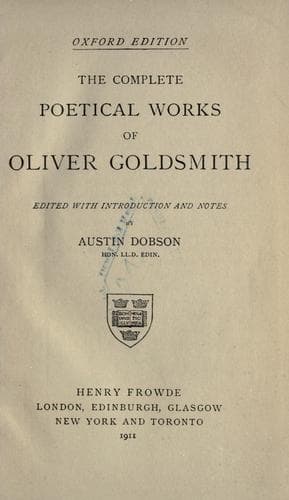
The Complete Poetical Works of Oliver GoldsmithGoldsmith, Oliver
General
The Complete Poetical Works of Oliver Goldsmith
Goldsmith, Oliver
English poetry; Literature -- Collections
The Oratorio of the _Captivity_ was written in 1764; but never
set to music. It was first printed in 1820 at pp. 451–70 of vol. ii of the
octavo edition of the _ Miscellaneous Works_ issued by the
trade in that year. Prior reprinted it in 1837 (_Works_, iv.
Pp. 79–95) from the ‘original manuscript’ in Mr. Murray’s possession; and
Cunningham again in 1854 (_Works_, i. pp. 63–76). It is here
reproduced from Prior. James Dodsley, who bought the MS. for Newbery and
himself, gave Goldsmith ten guineas. Murray’s copy was the one made for
Dodsley, October 31, 1764; the one printed in 1820, that made for Newbery.
The latter, which once belonged to the autograph collector, William
Upcott, was in the market in 1887.
AIR. Act i. This song had been published in the
first edition
of _The Haunch of Venison_, 1776, with the second stanza varied
thus:—
Thou, like the world, th’ opprest oppressing,
Thy smiles increase the wretch’s woe’
And he who wants each other blessing,
In thee must ever find a foe.
AIR. Act ii. This song also had appeared in the
first edition of _The Haunch of Venison_, 1776, in a different
form:—
The Wretch condemn’d with life to part,
Still, still on Hope relies;
And ev’ry pang that rends the heart,
Bids Expectation rise.
Hope, like the glim’ring taper’s light,
Adorns and chears the way;
And still, as darker grows the night,
Emits a brighter ray.
Mitford, who printed _The Captivity_ from Newbery’s version,
records a number of ‘first thoughts’ afterwards altered or improved by the
author in his MS. Modern editors have not reproduced them, and their
example has been followed here. _The Captivity_ is not, in any
sense, one of Goldsmith’s important efforts.
VERSES IN REPLY TO AN INVITATION TO DINNER.
These were first published in the _ Miscellaneous Works_ of
1837, iv. 132–3, having been communicated to the editor by Major-General
Sir H. E. Bunbury, Bart., the son of Henry William Bunbury, the well-known
comic artist, and husband of Catherine Horneck, the ‘Little Comedy’ to
whom Goldsmith refers. Dr. Baker, to whose house the poet was invited, was
Dr. (afterwards Sir George) Baker, 1722–1809. He was Sir Joshua’s doctor;
and in 1776 became physician to George III, whom he attended during his
illness of 1788–9. He is often mentioned by Fanny Burney and Hannah More.
Horneck, i.e. Mrs. Hannah Horneck—the
‘Plymouth Beauty’—widow of Captain Kane William Horneck, grandson
of Dr. Anthony Horneck of the Savoy, mentioned in Evelyn’s _Diary_,
for whose _Happy Ascetick_, 1724, Hogarth designed a
frontispiece. Mrs. Horneck died in 1803. Like Sir Joshua, the Hornecks
came from Devonshire; and through him, had made the acquaintance of
Goldsmith.
Public-domain text, read in full here on John Shaqi.
Reviews
Reviews
No reviews yet
Be the first to share your thoughts on this work.
Elsewhere in the archive
Join the Discussion
Join the discussion
Sign in to leave a comment or review.
Sign InorCreate an account