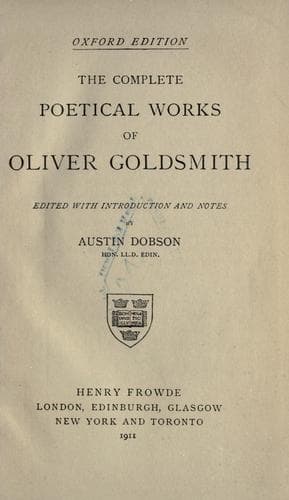
The Complete Poetical Works of Oliver GoldsmithGoldsmith, Oliver
General
The Complete Poetical Works of Oliver Goldsmith
Goldsmith, Oliver
English poetry; Literature -- Collections
This letter, which contains some of the brightest and easiest of
Goldsmith’s familiar verses, was addressed to Mrs. Bunbury (the ‘Little
Comedy’ of the _Verses in Reply to an Invitation to Dinner_,
pp. 250–2), in answer to a rhymed summons on her part to spend Christmas
at Great Barton in Suffolk, the family seat of the Bunburys. It was first
printed by Prior in the _Miscellaneous Works_ of 1837, iv.
148–51, and again in 1838 in Sir Henry Bunbury’s _Correspondence of
Sir Thomas Hanmer, Bart._, pp. 379–83. The text of the latter issue
is here followed. When Prior published the verses, they were assigned to
the year 1772; in the _Hanmer Correspondence_ it is stated that
they were ‘probably written in 1773 or 1774.’
your spring velvet coat. Goldsmith’s pronounced
taste in dress, and his good-natured simplicity, made his costume a
fertile subject for playful raillery,—sometimes, for rather
discreditable practical jokes. (See next note.)
a wig, that is modish and gay. ‘He always wore a
wig’—said the ‘Jessamy Bride’ in her reminiscences to Prior—‘a
peculiarity which those who judge of his appearance only from the fine poetical head
of Reynolds, would not suspect; and on one occasion some person contrived
to seriously injure this important adjunct to dress. It was the only one
he had in the country, and the misfortune seemed irreparable until the
services of Mr. Bunbury’s valet were called in, who however performed his
functions so indifferently that poor Goldsmith’s appearance became the
signal for a general smile’ (Prior’s _Life_, 1837, ii. 378–9).
Naso contemnere adunco. Cf. Horace, _Sat_.
i. 6. 5:—
naso suspendis adunco
Ignotos,
and Martial, _Ep_. i. 4. 6:—
Et pueri nasum Rhinocerotis habent.
Loo, i.e. Lanctre- or Lanterloo, a popular
eighteenth-century game, in which _Pam_, l. 6, the knave of clubs, is
the highest card. Cf. Pope, _Rape of the Lock_, 1714, iii. 61:—
Ev’n might _Pam_, that Kings and Queens o’erthrew,
And mow’d down armies in the fights of Lu;
and Colman’s epilogue to _The School for Scandal_, 1777:—
And at backgammon mortify my soul,
That pants for _loo_, or flutters at a vole?
Miss Horneck. Miss Mary Horneck, the ‘Jessamy
Bride’ _vide_ note, p. 251, l. 14).
Fielding. Sir John Fielding, d. 1780, Henry
Fielding’s blind half-brother, who succeeded him as a Justice of the Peace
for the City and Liberties of Westminster. He was knighted in 1761. There
are two portraits of him by Nathaniel Hone.
Public-domain text, read in full here on John Shaqi.
Reviews
Reviews
No reviews yet
Be the first to share your thoughts on this work.
Elsewhere in the archive
Join the Discussion
Join the discussion
Sign in to leave a comment or review.
Sign InorCreate an account