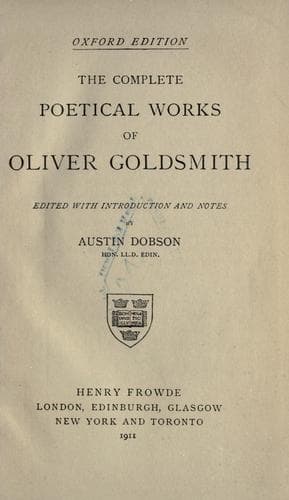
The Complete Poetical Works of Oliver GoldsmithGoldsmith, Oliver
General
The Complete Poetical Works of Oliver Goldsmith
Goldsmith, Oliver
English poetry; Literature -- Collections
by quinto Elizabeth, Death without Clergy. Legal
authorities affirm that the Act quoted should be 8 Eliz. cap. iv, under
which those who stole more than twelvepence ‘privately from a man’s
person’ were debarred from benefit of clergy. But ‘quint. Eliz.’ must have
offered some special attraction to poets, since Pope also refers to it in
the _Satires and Epistles_, i. 147–8:—
Consult the Statute: _quart_. I think, it is,
_Edwardi sext._ or _prim. et quint. Eliz._
With bunches of fennel, and nosegays before ’em.
This was a custom dating from the fearful jail fever of 1750, which
carried off, not only prisoners, but a judge (Mr. Justice Abney) ‘and many
jurymen and witnesses.’ ‘From that time up to this day [i.e. 1855] it has
been usual to place sweet-smelling herbs in the prisoner’s dock, to
prevent infection.’ (Lawrence’s _Life of Henry Fielding_, 1855,
p. 296.) The close observation of Cruikshank has not neglected this detail
in the Old Bailey plate of _The Drunkard’s Children_, 1848, v.
mobs. The mob was a loose undress or _dèshabillè_,
sometimes a hood. ‘When we poor souls had presented ourselves with a
contrition suitable to our worthlessness, some pretty young ladies in _mobs_,
popped in here and there about the church.’ (_Guardian_, No.
65, May 26, 1713.) Cf. also Addison’s ‘Fine Lady’s Diary’ (_Spectator_,
No. 323); ‘Went in our _Mobbs_ to the Dumb Man’ (Duncan Campbell).
yon solemn-faced. Cf. _Introduction_,
p. xxvii. According to the ‘Jessamy Bride,’ Goldsmith sometimes aggravated
his plainness by an ‘assumed frown of countenance’ (Prior, _Life_,
1837, ii. 379).
Sir Charles, i.e. Sir Thomas Charles Bunbury,
Bart., M. P., Henry Bunbury’s elder brother. He succeeded to the title in
1764, and died without issue in 1821. Goldsmith, it may be observed, makes
‘Charles’ a disyllable. Probably, like many of his countrymen, he so
pronounced it. (Cf. Thackeray’s _Pendennis_, 1850, vol. ii,
chap. 5 [or xliii], where this is humorously illustrated in Captain
Costigan’s ‘Sir _Chorlus_, I saw your neem at the Levee.’ Perhaps
this accounts for ‘failing’ and ‘stealing,’—‘day on’ and ‘Pantheon,’
in the _New Simile_. Cooke (_European Magazine_, October, 1793,
p. 259) says that Goldsmith ‘rather cultivated (than endeavoured to get
rid of) his brogue.’
dy’d in grain, i.e. fixed, ineradicable. To ‘dye
in grain’ means primarily to colour with the scarlet or purple dye
produced by the _kermes_ insect, called _granum_ in Latin, from
its similarity to small seeds. Being what is styled a ‘fast’ dye the
phrase is used by extension to signify permanence.
VIDA’S GAME OF CHESS.
Public-domain text, read in full here on John Shaqi.
Reviews
Reviews
No reviews yet
Be the first to share your thoughts on this work.
Elsewhere in the archive
Join the Discussion
Join the discussion
Sign in to leave a comment or review.
Sign InorCreate an account