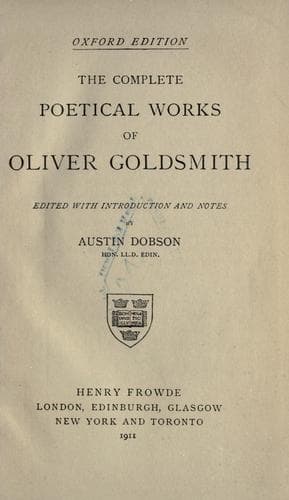
The Complete Poetical Works of Oliver GoldsmithGoldsmith, Oliver
General
The Complete Poetical Works of Oliver Goldsmith
Goldsmith, Oliver
English poetry; Literature -- Collections
This seems to be Mr. Pope’s most finished production, and is, perhaps, the
most perfect in our language. It exhibits stronger powers of imagination,
more harmony of numbers, and a greater knowledge of the world, than any
other of this poet’s works; and it is probable, if our country were called
upon to show a specimen of their genius to foreigners, this would be the
work here fixed upon.
THE HERMIT.
This poem is held in just esteem, the versification being chaste, and
tolerably harmonious, and the story told with perspicuity and conciseness.
It seems to have cost great labour, both to Mr. Pope and Parnell himself,
to bring it to this perfection.* It may not be amiss to observe that the
fable is taken from one of Dr. Henry More’s Dialogues.
*Parnell’s _Poems_, 1770, xxiv.
IL PENSEROSO.
I have heard a very judicious critic say, that he had an higher idea of
Milton’s style in poetry, from the two following poems [_Il Penseroso_
and _ l’Allegro_], than from his _Paradise Lost_. It
is certain the imagination shown in them is correct and strong. The
introduction to both in irregular measure is borrowed from the Italian,
and hurts an English ear.
AN ELEGY, WRITTEN IN A COUNTRY CHURCH YARD.
This is a very fine poem, but overloaded with epithet.† The heroic
measure with alternate rhyme is very properly adapted to the solemnity of
the subject, as it is the slowest movement that our language admits of.
The latter part of the poem is pathetic and interesting.
†This is a
strange complaint to come from Goldsmith, whose own _Hermit_,
as was pointed out to the present Editor by the late Mr. Kegan Paul, is
certainly open to this impeachment.
LONDON. IN IMITATION OF THE THIRD SATIRE
OF JUVENAL.
This poem of Mr. Johnson’s is the best imitation of the original that has
appeared in our language, being possessed of all the force and satirical
resentment of Juvenal. Imitation gives us a much truer idea of the
ancients than even translation could do.
THE SCHOOL-MISTRESS. IN IMITATION OF SPENSER.
This poem is one of those happinesses in which a poet excels himself, as
there is nothing in all Shenstone which in any way approaches it in merit;
and, though I dislike the imitations of
our old English poets in general, yet, on this minute subject, the
antiquity of the style produces a very ludicrous solemnity.
COOPER’S HILL.
This poem, by Denham, though it may have been exceeded by later attempts
in description, yet deserves the highest applause, as it far surpasses all
that went before it: the concluding part, though a little too much
crowded, is very masterly.
ELOISA TO ABELARD.
Public-domain text, read in full here on John Shaqi.
Reviews
Reviews
No reviews yet
Be the first to share your thoughts on this work.
Elsewhere in the archive
Join the Discussion
Join the discussion
Sign in to leave a comment or review.
Sign InorCreate an account