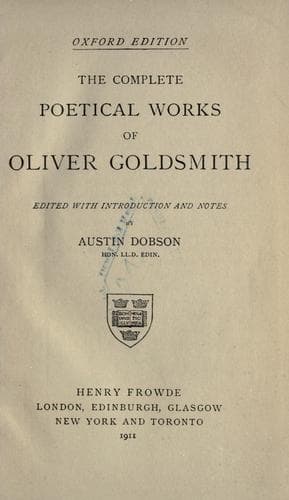
The Complete Poetical Works of Oliver GoldsmithGoldsmith, Oliver
General
The Complete Poetical Works of Oliver Goldsmith
Goldsmith, Oliver
English poetry; Literature -- Collections
The harmony of numbers in this poem is very fine. It is rather drawn out
to too tedious a length, although the passions vary with great judgement.
It may be considered as superior to anything in the epistolary way; and
the many translations which have been made of it into the modern
languages, are in some measure a proof of this.
AN EPISTLE FROM MR. PHILIPS [Ambrose Philips] TO THE EARL OF DORSET.
The opening of this poem is incomparably fine. The latter part is tedious
and trifling.
A LETTER FROM ITALY, TO THE RIGHT HONOURABLECHARLES LORD HALIFAX.
In the Year MDCCI.
Few poems have done more honour to English genius than this. There is in
it a strain of political thinking that was, at that time, new in our
poetry. Had the harmony of this been equal to that of Pope’s
versification, it would be incontestably the finest poem in our language;
but there is a dryness in the numbers which greatly lessens the pleasure
excited both by the poet’s judgement and imagination.*
* See introductory note to _The Traveller_, p. 162.
ALEXANDER’S FEAST; OR, THE POWER OF MUSIC.
AN ODE, IN HONOUR OF ST. CECILIA’S DAY.
This ode [by Mr. Dryden] has been more applauded, perhaps, than it has
been felt, however, it is a very fine one, and gives its beauties rather
at a third, or fourth, than at a first perusal.
ODE FOR MUSIC ON ST. CECILIA’S DAY.
This ode [by Mr. Pope] has by many been thought equal to the former. As it
is a repetition of Dryden’s manner, it is so far inferior to him. The
whole hint of Orpheus, and many of the lines, have been taken from an
obscure Ode upon Music, published in Tate’s Miscellanies.*
*_A Pindaric Essay upon Musick_—says Gibbs—by
‘Mr. Wilson’,’ which appears at p. 401 of Tate’s Collection of 1685.
THE SHEPHERD’S WEEK. IN SIX PASTORALS.
These are Mr. Gay’s principal performances. They were originally intended,
I suppose, as a burlesque on those of [Ambrose] Philips; but, perhaps
without designing it, he has hit the true spirit of pastoral poetry. In
fact, he more resembles Theocritus than any other English pastoral writer
whatsoever. There runs through the whole a strain of rustic pleasantry
which should ever distinguish this species of composition; but how far the
antiquated expressions used here may contribute to the humour, I will not
determine; for my own part, I could wish the simplicity were preserved,
without recurring to such obsolete antiquity for the manner of expressing
it.
MAC FLECKNOE.
Public-domain text, read in full here on John Shaqi.
Reviews
Reviews
No reviews yet
Be the first to share your thoughts on this work.
Elsewhere in the archive
Join the Discussion
Join the discussion
Sign in to leave a comment or review.
Sign InorCreate an account