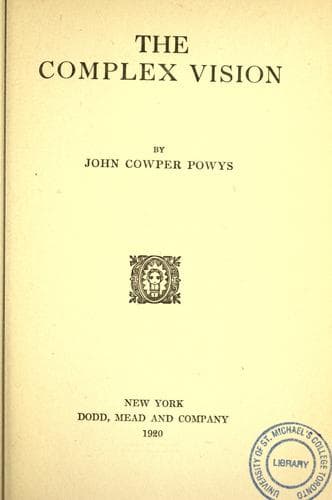
Here also we are confronted by the metaphorical danger, which is
a danger springing from the necessity of thought itself; the
necessity under which thought labours of being compelled to use
sense-impressions if it is to function at all. But though thought
cannot exist as thought without the use of sense-impressions it can
at least concentrate its attention upon this primal necessity and be
aware of it and cautious of it and hypercritical in its use. It can do
more than this. It can throw back, so to speak, the whole weight of
the mystery and drive it so rigorously to the ultimate wall, that the
materialistic and metaphorical element is reduced to a mere gap or
space or lacuna in the mind that only a material element can fill
and yet that we cannot imagine being filled by any material
element which we are able to define.
This is precisely what we have to do with regard to that
"vanishing-point of sensation" which is the substratum of the soul.
The situation resolves itself into this. The highest, deepest, most
precious thing we know or can imagine is _personality_.
Personality is and must be our ultimate synthesis, our final ideal,
and the origin of all our ideals. Nothing can be conceived more
true, more real, more spiritual than personality.
All conceptions, qualities, principles, forces, elements, thoughts,
ideas, are things which we abstract from personality, and project
into the space which surrounds us, as if they could be independent
of the personal unity from which they have been taken. We are
compelled by the inevitable necessity of thought itself, which
cannot escape from the world of sense-impressions, to think of
personality as possessing for its "substratum" "something" which
gives it concrete reality. This "something" which is utterly
indefinable, is the last gesture, so to speak, made by the
sense-world before it vanishes away.
This "something" which is the substratum of the soul and the thing
which gives unity and concreteness to the soul is the thinnest and
remotest attenuation of the world of sense-impression. It is far
thinner and more remote than the sense-element in our conception
of spirit. Why, it may be asked, can we not get rid of this
"something" which fills that gap or lacuna in the identity of the
soul which can only be thought of in material terms?
We cannot get rid of it because directly we attempt to do so we are
left with that vague idealistic abstraction upon our hands which we
call "thought-in-the-abstract"--or "pure thought" or "pure
self-consciousness." But it may be asked--"Why cannot the physical
body serve this necessary purpose of giving personality a local and
concrete identity?"
First--and this is the psychological reason--it cannot do so because
our feeling of the soul as "something within" our physical body is
an ultimate fact of experience which would then remain as an
experience denied and contradicted.
Public-domain text, read in full here on John Shaqi.
Reviews
Reviews
No reviews yet
Be the first to share your thoughts on this work.
Elsewhere in the archive
Join the Discussion
Join the discussion
Sign in to leave a comment or review.
Sign InorCreate an account