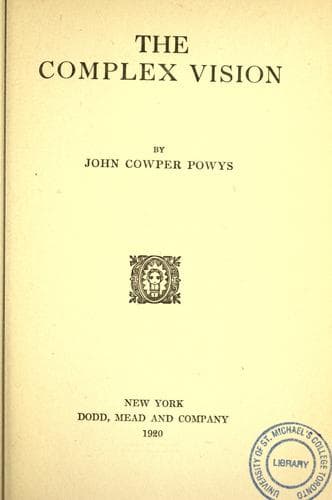
To the larger vision of these "invisible companions" we find
ourselves consciously and sub-consciously turning whenever the
burden of our flesh oppresses us more than we can bear. We are
compelled to turn to them by reason of the profound instinct in us
which recognizes that our ideas of truth, of beauty, and goodness
are not mere subjective fancies but are actual objective realities.
These ideas do not spring from these "companions" or find their
origin and cause in them, any more than they spring from some
imaginary "parent" of the universe and find their origin and cause
in something "behind life." They do not "spring" from anything at
all; but are the very stuff and texture of our own unfathomable
souls, just as they are the very stuff and texture of the
unfathomable souls of the immortal gods. What we are conscious
of, when our complex vision gathers itself together, is the fact that
the inevitable element of subjectivity in our individual feeling
about these things is transcended and supplemented by an invisible
pattern or standard or ideal in which these things are reconciled
and fused together at a higher pitch of harmony than we individually,
or even in contact with one another, are capable of attaining.
The vision of these "invisible companions"--absolute enough in
relation to our own tragic relativity--is itself relative to its own
hope, its own dream, its own prophecy, its own premonition. The
real evolution of the world, the real movement of life, takes
therefore a double form. It takes the form of an individual _return_
to the fulness of ideas which have always been implicit and latent
in our individual souls. And it takes the form of a co-operative
_advance_ towards the fulness of ideas which are foreshadowed
and prophesied in the vision of these immortals' companions. Thus
for us, as well as for them, the eternal movement is at once an
advance and a return. Thus for us, as well as for them, the eternal
inspiration is at once a hope and a reminiscence.
It will be seen from what I have said that this philosophy of the
complex vision finds a place for all the nobler and more desperate
struggles of the human race towards a solution of the mystery of
life. It accepts fully the fact that the human reason playing isolated
games with itself, is driven by its own nature to reduce "all objects
of all thought" to the circle of one "synthetic unity" which is the
implied "a priori" background of all actual vision. It accepts fully
the fact that human self-consciousness, playing isolated games
with itself, is driven by the necessity of its own nature to reduce all
separate "selves" to one all embracing "world self" which is the
universe conscious of itself as the universe.
Public-domain text, read in full here on John Shaqi.
Reviews
Reviews
No reviews yet
Be the first to share your thoughts on this work.
Elsewhere in the archive
Join the Discussion
Join the discussion
Sign in to leave a comment or review.
Sign InorCreate an account