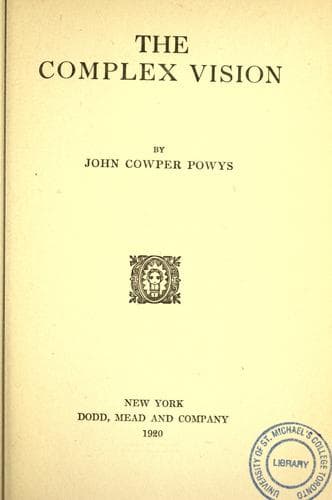
It is a well-known psychological fact that the complex vision can
energize, with vigorous spontaneity, through the will alone, just as it
can energize through sensation alone. The will can, so to speak,
stretch its muscles and gather itself together for attack or defence at
a moment when there is no particular necessity for its use.
Some degree of self-consciousness is bound to accompany this
"motiveless stretching" of the will, for the simple reason that it is
not "will in the abstract" which makes such a movement but the
totality of the complex vision, though in this case all other
attributes of the complex vision, including self-consciousness and
reason, are held in subordination to the will.
Man is a philosophical animal; and he philosophizes as inevitably as
he breathes. He is also an animal possessed of will; and he uses his
will as inevitably as, in the process of breathing, he uses his lungs
or his throat. Around him, from the beginning, all manner of motives
may flutter like birds on the wing. They may be completely
different motives in the case of different personalities. But in all
personalities there is consciousness, to grasp these motives; and in
all personalities there is will, to accept or to reject these motives.
The question of the freedom of the will is a question which
necessarily enters into our discussion.
The will feels itself--or rather consciousness feels the will to be--at
once free and limited. The soul does not feel it is free to do anything
it pleases. That at least is certain. For without some limitation,
without something resistant to exert itself upon, the will could not
be known. An absolutely free will is unthinkable. The very nature of
the will implies a struggle with some sort of resistance.
The will is, therefore, by the terms of its original definition and by
the original feeling which the soul experiences in regard to it,
limited in its freedom. The problem resolves itself, therefore, if once
we grant the existence of the will, into the question of how much
freedom the will has or how far it is limited. Is it, for instance, when
we know all the conditions of its activity, entirely limited? Is the
freedom of the will an illusion?
It is just at this point that the logical reason makes a savage attempt
to dominate the situation. The logical reason arrives step by step at
the inevitable conclusion that the will has no freedom at all but is
absolutely limited.
On the other hand emotion, instinct, imagination, intuition, and
conscience, all assume that the limitation of the will is not absolute
but that within certain boundaries, which themselves are by no
means fixed or permanent, the will is free.
Public-domain text, read in full here on John Shaqi.
Reviews
Reviews
No reviews yet
Be the first to share your thoughts on this work.
Join the Discussion
Join the discussion
Sign in to leave a comment or review.
Sign InorCreate an account