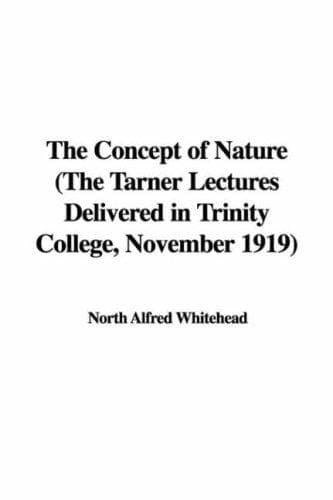
The Concept of Nature: The Tarner Lectures Delivered in Trinity College, November 1919Whitehead, Alfred North
Philosophy
The Concept of Nature: The Tarner Lectures Delivered in Trinity College, November 1919
Whitehead, Alfred North
Knowledge, Theory of; Nature; Science -- Philosophy
The durations which enter into the composition of a moment all belong to
one family. Thus there is one family of moments corresponding to one
family of durations. Also if we take two moments of the same family,
among the durations which enter into the composition of one moment the
smaller durations are completely separated from the smaller durations
which enter into the composition of the other moment. Thus the two
moments in their intrinsic properties must exhibit the limits of
completely different states of nature. In this sense the two moments are
completely separated. I will call two moments of the same family
'parallel.'
Corresponding to each duration there are two moments of the associated
family of moments which are the boundary moments of that duration. A
'boundary moment' of a duration can be defined in this way. There are
durations of the same family as the given duration which overlap it but
are not contained in it. Consider an abstractive set of such durations.
Such a set defines a moment which is just as much without the duration
as within it. Such a moment is a boundary moment of the duration. Also
we call upon our sense-awareness of the passage of nature to inform us
that there are two such boundary moments, namely the earlier one and the
later one. We will call them the initial and the final boundaries.
There are also moments of the same family such that the shorter
durations in their composition are entirely separated from the given
duration. Such moments will be said to lie 'outside' the given duration.
Again other moments of the family are such that the shorter durations in
their composition are parts of the given duration. Such moments are said
to lie 'within' the given duration or to 'inhere' in it. The whole
family of parallel moments is accounted for in this way by reference to
any given duration of the associated family of durations. Namely, there
are moments of the family which lie without the given duration, there
are the two moments which are the boundary moments of the given
duration, and the moments which lie within the given duration.
Furthermore any two moments of the same family are the boundary moments
of some one duration of the associated family of durations.
Public-domain text, read in full here on John Shaqi.
Reviews
Reviews
No reviews yet
Be the first to share your thoughts on this work.
Join the Discussion
Join the discussion
Sign in to leave a comment or review.
Sign InorCreate an account