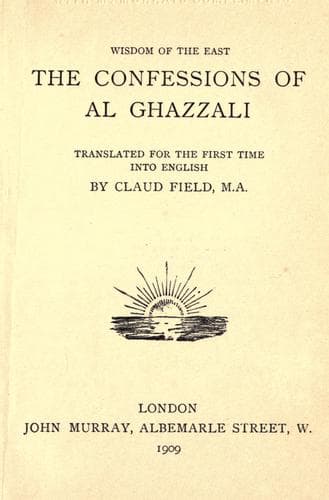
Ghazzali, 1058-1111; Islamic philosophy -- Early works to 1800; Sufism -- Early works to 1800
Such is the origin of scholastic theology. Many of its adepts, worthy of
their high calling, valiantly defended the orthodox faith by proving the
reality of prophecy and the falsity of heretical innovations. But, in
order to do so, they had to rely upon a certain number of premises, which
they accepted in common with their adversaries, and which authority and
universal consent or simply the Koran and the traditions obliged them
to accept. Their principal effort was to expose the self-contradictions
of their opponents and to confute them by means of the premises which
they had professed to accept. Now a method of argumentation like this
has little value for one who only admits self-evident truths. Scholastic
theology could not consequently satisfy me nor heal the malady from which
I suffered.
It is true that in its later development theology was not content merely
to defend dogma; it betook itself to the study of first principles,
of substances, accidents and the laws which govern them; but through
want of a thoroughly scientific basis, it could not advance far in its
researches, nor succeed in dispelling entirely the overhanging obscurity
which springs from diversities of belief.
I do not, however, deny that it has had a more satisfactory result for
others; on the contrary, I admit that it has; but it is by introducing
the principle of authority in matters which are not self-evident.
Moreover, my object is to explain my own mental attitude and not to
dispute with those who have found healing for themselves. Remedies vary
according to the nature of the disease; those which benefit some may
injure others.
* * * * *
PHILOSOPHY.—How far it is open to censure or not—On what points its
adherents may be considered believers or unbelievers, orthodox or
heretical—What they have borrowed from the true doctrine to render their
chimerical theories acceptable—Why the minds of men swerve from the
truth—What criteria are available wherewith to separate the pure gold
from the alloy in their systems.
Public-domain text, read in full here on John Shaqi.
Reviews
Reviews
No reviews yet
Be the first to share your thoughts on this work.
Join the Discussion
Join the discussion
Sign in to leave a comment or review.
Sign InorCreate an account