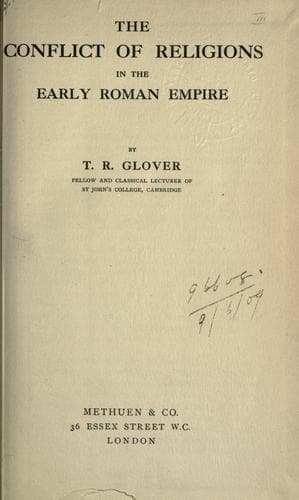
The Conflict of Religions in the Early Roman EmpireGlover, T. R. (Terrot Reaveley)
Religion
The Conflict of Religions in the Early Roman Empire
Glover, T. R. (Terrot Reaveley)
Christianity and other religions; Church history -- Primitive and early church, ca. 30-600; Rome -- Religion
[44] _Cons. ad Ux._ 2-3, 608 C, D.
[45] _Cons. ad Ux._ 11, 612 A, B. Cf. _non suaviter_, 26, 1104 C, on
the loss of a child or a parent.
[46] _de coh. ira._ 11, 459 C; cf. _Progress in Virtue_, 80 B, 81 C, on
_epieikeia_ and _praotes_ as signs of moral progress.
[47] Cf. Sen. _Ep._ 47; Clem. Alex. _Paed._ iii, 92.
[48] A curious parallel to this in Tert. _de Patientia_, 15, where
Tertullian draws the portrait of Patience--perhaps from life, as Dean
Robinson suggests--after Perpetua the martyr.
[49] Gellius, _N.A._ i, 26.
[50] _Solon_, 32.
[51] Artemidorus, _Oneirocritica_, iv, 72. On this author see chapter
vii.
[52] See _non suaviter_, 17, 1098 D, on the unspeakably rich joy of
such a life of friendly relations with gods and men.
[53] _Progress in Virtue_, 4, 77 C, Love of Philosophy compared to a
lover's passion, to "hunger and thirst."
[54] Plato, _Apology_, 38 A, _ho de anexetastos bios ou biotos
anthropo_.
[55] _Pensees_, Art. xxiv, 5.
[56] _Adv. Coloten_ (foe Epicurean), 31, 1125 D, E. For this argument
from consensus, see Seneca, _Ep._ 117, 6, _Multum dare solemus
praesumptioni omnium hominum et apud nos veritatis argumentum est
aliquid omnibus videri: tanquam deos esse inter alia hoc colligimus,
quod omnibus insita de dis opinio est, nee ulla gens usquam est adeo
extra leges moresque projecta ut non aliquos deos credat_. This
consensus rests (with the Stoics) on the common preconceptions of the
mind, which are natural. For ridicule of the doctrine of consensus,
see Lucian, Zeus Tragaedus, 42.
[57] _Amatorius_, 18, 763 C. Cf. view of Celsus _ap._ Orig. _c. Cels._
vii, 41.
[58] _Consol. ad Apoll._ 34, 120 B.
[59] _Quomodo Poetas_, 1, 15 E, F, poetry a preliminary study to
philosophy, _prophilosopheteon tois poiemasin_.
[60] _de Pyth. orac._ 29, 408 F. Cf. the pagan's speech in Minucius
Felix, 7, 6, _pleni et mixti deo vates futura praecerpunt ... etiam per
guietem deos videmus_....
[61] So Volkmann, _Plutarch_, ii, 290 n. Cf. a passage of Celsus,
Orig. _c. Cels._ viii, 45.
[62] _de def. or._ 14, 417 C, _emphaseis_ and _diaphaseis_.
[63] Tertullian sums up the pagan line of argument and adds a telling
criticism in his book _adversus Nationes_, ii, 1: _adversus haec igitur
nobis negotium est, adversus institutiones maiorum, auctoritates
receptorum, leges dominantium, argumentationes prudentium, adversus
vetustatem consuetudinem necessitatem, adversus exempla prodigia
miracula, quae omnia adulterinam istam divinitatem corroboraverint....
Maior in huiusmodi penes vos auctoritas litterarum quam rerum est_.
[64] _de Iside_, 67, 377 F-378 A
[65] Oakesmith, _Religion of Plutarch_, p. 88--a book which I have
found of great use.
[66] _de E._ 18-20. Cf. Clem. Alex. _Protr._ 84. The true To-day of
God is eternity. Also Tert. _ad Natt._ ii, 6, on the axiom of no
change in God.
[67] _de E._ 21.
[68] Cf. Plato, _Timaeus_, 55 D.
Public-domain text, read in full here on John Shaqi.
Reviews
Reviews
No reviews yet
Be the first to share your thoughts on this work.
Elsewhere in the archive
Join the Discussion
Join the discussion
Sign in to leave a comment or review.
Sign InorCreate an account