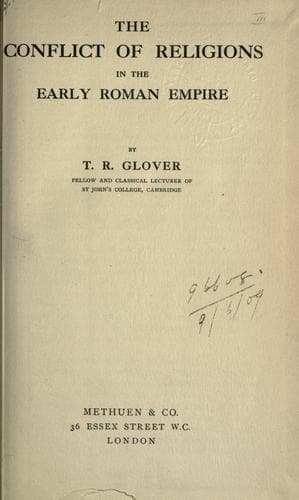
The Conflict of Religions in the Early Roman EmpireGlover, T. R. (Terrot Reaveley)
Religion
The Conflict of Religions in the Early Roman Empire
Glover, T. R. (Terrot Reaveley)
Christianity and other religions; Church history -- Primitive and early church, ca. 30-600; Rome -- Religion
emotions of ancestral piety--and so unspeakably inferior in essential
truthfulness.
The ancient world rejected Seneca, as we have seen, and chose Plutarch.
If Plutarch was not the founder of Neo-Platonism, he was one of its
precursors and he showed the path. Down that path ancient religion
swung with deepening emotion into that strange medley of thought and
mystery, piety, magic and absurdity, which is called the New Platonism
and has nothing to do with Plato. Here and there some fine spirit
emerged into clearer air, and in some moment of ecstasy {112} achieved
"by a leap" some fleeting glimpse of Absolute Being, if there is such a
thing. But the mass of men remained below in a denser atmosphere,
prisoners of ignorance and of fancy--in an atmosphere not merely dark
but tainted, full of spiritual and intellectual death.
Chapter III Footnotes:
[1] _Amatorius_, 13, 756 A, D; 757 B. The quotation is from Euripides,
_Bacchae_, 203.
[2] _Non suaviter_, 21, 1101 E-1102 A.
[3] _de Iside_, 68, 378 A.
[4] _de def. orac._ 8, 414 A.
[5] Mahaffy, _Silver Age of Greek World_, p. 45.
[6] Horace is the best known of Athenian students. The delightful
letters of Synesius show the hold Athens still retained upon a very
changed world in 400 A.D.
[7] Life of Antony, 68.
[8] _Symp._ i, 5, 1.
[9] _Symp._ iv, 4, 4.
[10] _v. Ant._ 28.
[11] _Symp._ iii, 7, 1.
[12] _Symp._ ii, 8, 1.
[13] _Symp._ viii, 6, 5, _hubristes on kai philogelos physei_. _Symp._
ix, 15, 1.
[14] _de fraterno amore_, 16, 487 E. Volkmann, _Plutarch_, i, 24,
suggests he was the Timon whose wife Pliny defended on one occasion,
_Epp._ i, 5, 5.
[15] _de frat. am._ 7, 481 D.
[16] _de E._ 1, 385 B.
[17] _v. Them._ 32, end.
[18] Zeller, _Eclectics_, 334.
[19] _de E._ 17, 391 E. Imagine the joys of a Euclid, says Plutarch,
in _non suaviter_, 11, 1093 E.
[20] _Symp._ ix, 15.
[21] _Symp._ viii, 3, I.
[22] _Pericles_ 13.
[23] Dio Chr. _Rhodiaca, Or._ 31, 117.
[24] Cf. the _Nigrinus_.
[25] Gellius, N.A. ii, 21, 1, _vos opici_, says Gellius to his
friends--Philistines.
[26] _Symp._ v, 5, 1.
[27] _Polit. praec._ 20, 816 D.
[28] _de curiositate_, 15.
[29] _Demosthenes_, 2.
[30] See Volkmann, i, 35, 36; _Rom. Qu._ 103; _Lucullus_, 37, end.
[31] _Demosthenes_, 2.
[32] _de sera_, 15, 559 A.
[33] _de Stoic. rep._ 2, 1033 B, C.
[34] _Pol. Praec._ 15, 811 C.
[35] _Symp._ ii, 10, 1; vi, 8, 1.
[36] Reference to Polemo's hand-book to them, _Symp._ v, 2, 675 B.
[37] _de E._ 384 F.
[38] _Demosthenes_, 2; and 1.
[39] _Timoleon_, pref.
[40] _Alexander_, 1.
[41] _de tranqu. animi_, i, 464 F, _ouk akroaseos heneka theromenes
kalligraphian_--a profession often made, but in Plutarch's case true
enough as a rule.
[42] See, _e.g._, variety of possible explanations of the E at Delphi,
in tract upon it.
[43] Stapfer, _Shakespeare and Classical Antiquity_ (tr.), p. 299. "It
may be safely said he followed Plutarch far more closely than he did
even the old English chroniclers."
Public-domain text, read in full here on John Shaqi.
Reviews
Reviews
No reviews yet
Be the first to share your thoughts on this work.
Elsewhere in the archive
Join the Discussion
Join the discussion
Sign in to leave a comment or review.
Sign InorCreate an account