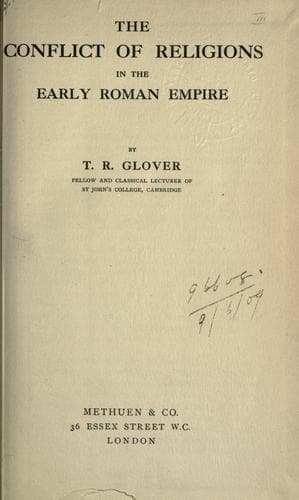
The Conflict of Religions in the Early Roman EmpireGlover, T. R. (Terrot Reaveley)
Religion
The Conflict of Religions in the Early Roman Empire
Glover, T. R. (Terrot Reaveley)
Christianity and other religions; Church history -- Primitive and early church, ca. 30-600; Rome -- Religion
[80] _de Iside_, 26, 361 C. Cf. Plato, _Sympos._ 202 E, 203 A
(referred to above), for the functions of _to daimonion_, which is
_metaxu theou te kai thnetou ... hermeneuon kai diamorthmeuon theois ta
par anthropon kai anthropois ta para theon kthe ... theos de anthropo
ou mignutai ... ou toi de daimones polloi kai pantodapoi eisin, eis de
touton esti kai ho Eros_.
[81] _de def. orac._ 10, 414 F-415 A.
[82] _de Iside_, 27, 361 E; _de def. orac._ 10, 415 C; cf. Tert. _ad
Natt._ ii, 2.
[83] _Romulus_, 28; _de def. orac._ 10, 415 B.
[84] Hesiod, _Works and Days_, 121. "But," asks Tatian (c. 16), "why
should they get _drastikoteras dynameos_ after death?" See the reply
given by Plutarch, _de def. orac._ 39, 431 E. Compare also views of
Apuleius (_de deo Socr._ 15) cited on p. 233.
[85] _de genio Socratis_, 24, 593 D-F. He is thinking of the series of
rebirths.
[86] On such places and on necromancy in general see Tertullian, _de
anima_, 57, who puts it down to illusion of the evil one--_nec magnum
illi exteriores oculos circumscribere cui interiorem mentis aciem
excaecare perfacile est_.
[87] Cf. p. 15 on the _genius_ and the _fravashi_.
[88] _de tranqu. animi_, 15, 474 B.
[89] Cf. the story of the appearance to Brutus of his evil genius--_ho
sos_, _o broute_, _daimon kakos_, Brutus, 36. Basilides the Gnostic
(the father of Isidore) is credited with describing Man as a sort of
Wooden Horse with a whole army of different spirits in him (Clem. Alex.
_Strom_, ii, 113). Plutarch makes a similar jibe at the Stoic account
of arts, virtues, vices, etc., as corporeal or even animate and
rational beings--making a man "a Paradise, or a cattle-pen, or a Wooden
Horse," _de commun. notit. adv. Stoicos_, 45, 1084 B. There was a
tendency in contemporary psychology to attribute all feelings, etc., to
daemonic influence; cf. Clem. Alex. _Strom._ ii, 110, who suggests that
all _pathe_ are imprints (as of a seal) made on the soul by the
spiritual powers against which we have to wrestle. Cf. Tert. _de
Anima_, 41, the evil of soul in part due to evil spirit.
[90] Clement says (_Strom._ vi, 53) that Isidore the Gnostic "in the
first book of the expositions of Parchor the Prophet" dealt with the
daemon of Socrates and quoted Aristotle's authority for such tutelary
spirits. For the book of Apuleius, see ch. vii.
[91] Porphyry, _v. Plotini_, 10. Cf. Origen, _c. Cels._ vii, 35, for
Celsus' views on the visibility of daemons, _e.g._ in the cave of
Trophonius.
[92] _Life of Numa_, 4--a most interesting chapter, when it is
remembered what other works were being written contemporaneously.
[93] _de genio Socr._ 20, 588 D, 589 D.
[94] _de gen. Socr._ 24, 593 D.
[95] _de def. orac._ 38, 431 C, _phantasias tou mellontos_.
[96] Cf. Clem. Alex. _Strom._ vi, 46, on preaching of Christ in Hades,
where souls, rid of the flesh, see more clearly.
Public-domain text, read in full here on John Shaqi.
Reviews
Reviews
No reviews yet
Be the first to share your thoughts on this work.
Elsewhere in the archive
Join the Discussion
Join the discussion
Sign in to leave a comment or review.
Sign InorCreate an account