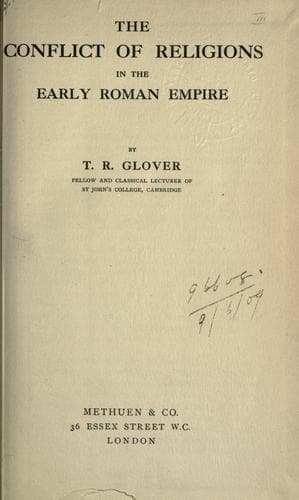
The Conflict of Religions in the Early Roman EmpireGlover, T. R. (Terrot Reaveley)
Religion
The Conflict of Religions in the Early Roman Empire
Glover, T. R. (Terrot Reaveley)
Christianity and other religions; Church history -- Primitive and early church, ca. 30-600; Rome -- Religion
Towards the end of the first century of our era, there began to appear
a number of little books, written in the ordinary Greek of every-day
life, the language which the common people used in conversation and
correspondence. It was not the literary dialect, which men of letters
affected--a mannered and elaborate style modelled on the literature of
ancient Greece and no longer a living speech. The books were not
intended for a lettered public, but for plain people who wanted a plain
story, which they knew already, set down in a handy and readable form.
The writers did their work very faithfully--some of them showing a
surprising loyalty to the story which they had received. Like other
writers they were limited by considerations of space and so forth, and
this involved a certain freedom of choice in selecting, omitting,
abridging and piecing together the material they gathered. Four only
of the books survive intact; of others there are scanty fragments; and
scholars have divined at least one independent work embodied in two
that remain. So far as books can, three of them represent very fairly
the ideas of an earlier generation, as it was intended they should, and
tell their common story, with the variations natural to individual
writers, but with a general harmony that is the pledge of its truth.
[Sidenote: The Gospels]
At an early date, these books began to be called Gospels[1] and by the
time they had circulated for a generation they were {114} very widely
known and read among the community for which they were written. Apart
from a strong instinct which would allow no conscious change to be made
in the lineaments of the central figure of the story, there was nothing
to safeguard the little books from the fate of all popular works of
their day. Celsus, at the end of the second century, maintained that a
good deal of the story was originally invention; and he added that the
"believers" had made as free as drunk men with it and had written the
gospel over again--three times, four times, many times--and had altered
it to meet the needs of controversy.[2] Origen replied that Marcion's
followers and two other schools had done so, but he knew of no others.
It may to-day be taken as established that the four gospels, as we know
them, stand substantially as near the autograph of their authors as
most ancient books which were at all widely read, though here and there
it is probable, or even certain, that changes on a slight scale have
been made in the wording to accommodate the text to the development of
Christian ideas.[3] This is at first sight a serious qualification,
but it is not so important as it seems. By comparison of the first
three gospels with one another, with the aid of the history of their
transmission in the original Greek and in many versions and quotations,
it is not very difficult to see where the hand of a later day has
touched the page and to break through to something in all probability
very near the original story.
Public-domain text, read in full here on John Shaqi.
Reviews
Reviews
No reviews yet
Be the first to share your thoughts on this work.
Elsewhere in the archive
Join the Discussion
Join the discussion
Sign in to leave a comment or review.
Sign InorCreate an account