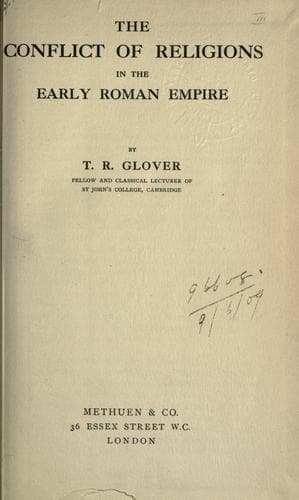
The Conflict of Religions in the Early Roman EmpireGlover, T. R. (Terrot Reaveley)
Religion
The Conflict of Religions in the Early Roman Empire
Glover, T. R. (Terrot Reaveley)
Christianity and other religions; Church history -- Primitive and early church, ca. 30-600; Rome -- Religion
This is the greatest problem of literary and historical criticism
to-day. All sorts of objections have been raised against the
credibility of the gospels from the time of Celsus--they were raised
even earlier; for Celsus quotes them from previous
controversialists--and they are raised still. We are sometimes told
that we cannot be absolutely certain of the authenticity of any single
saying of Jesus, or perhaps of any recorded episode in his life. A
hypertrophied conscience might admit this to be true in the case of any
word or deed of Jesus that might be quoted, and yet maintain that we
have not lost much. For, it is a commonplace of historians that an
anecdote, even if false in itself, may contain historical truth; it
{115} may be evidence, that is, to the character of the person of whom
it is told; for a false anecdote depends, even more than a true story,
upon keeping the colour of its subject. It may be added that, as a
rule, false anecdotes are apt to be more highly coloured than true
stories, just as a piece of colour printing is generally a good deal
brighter than nature. The reader, who, by familiarity with books, and
with the ways of their writers, has developed any degree of literary
instinct, will not be inclined to pronounce the colours in the first
three gospels at least to be anything but natural and true. However,
even if one were to concede that all the recorded sayings and doings of
Jesus are fabrications (a wildly absurd hypothesis), there remains a
common element in them, a unity of tone and character, which points to
a well-known and clearly marked personality behind them, whose actual
existence is further implied by the Christian movement. In other
words, whether true or false in detail, the statements of the gospels,
if we know how to use them aright, establish for us the historicity of
Jesus, and leave no sort of doubt as to his personality and the
impression he made upon those who came into contact with him.
Public-domain text, read in full here on John Shaqi.
Reviews
Reviews
No reviews yet
Be the first to share your thoughts on this work.
Elsewhere in the archive
Join the Discussion
Join the discussion
Sign in to leave a comment or review.
Sign InorCreate an account