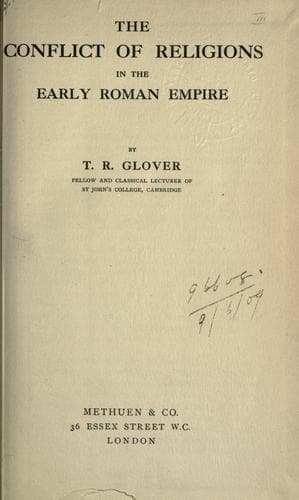
The Conflict of Religions in the Early Roman EmpireGlover, T. R. (Terrot Reaveley)
Religion
The Conflict of Religions in the Early Roman Empire
Glover, T. R. (Terrot Reaveley)
Christianity and other religions; Church history -- Primitive and early church, ca. 30-600; Rome -- Religion
In every endeavour made by any man to reconstruct another's
personality, there will always be a subjective and imaginative element.
Biography is always a work of the imagination. The method has its
dangers, but without imagination the thing is not to be done at all. A
great man impresses men in a myriad of different ways--he is as various
and as bewilderingly suggestive as Nature herself--and no two men will
record quite the same experience of him. Where the imagination has to
penetrate an extraordinary variety of impressions, to seize, not a
series of forces each severally making {117} its own impression, but a
single personality of many elements and yet a unity, men may well
differ in the pictures they make. Even the same man will at different
times be differently impressed and not always be uniformly able to
grasp and order his impressions. Hence it is that biographies and
portraits are so full of surprises and disappointments, while even the
writer or the painter will not always accept his own interpretation--he
outgrows it and detests it. And if it is possible to spend a life in
the realization of the simplest human nature, what is to be said of an
attempt to make a final picture of Jesus of Nazareth? Still the effort
must be made to apprehend what he was to those with whom he lived, for
from that comes the whole Christian movement.
[Sidenote: Celsus on "coarseness" of Jesus]
Celsus denounced Jesus in language that amazes us; but when he was
confronted with the teaching of Jesus, the moral worth of which a mind
so candid could not deny, he admitted its value, but he attributed it
to the fact that Jesus plagiarized largely from Greek philosophy and
above all from Plato. He did not grasp, Celsus adds, how good what he
stole really was, and he spoiled it by his vulgarity of phrase. In
particular, Celsus denounced the saying "Whosoever shall smite thee on
the right cheek, turn to him the other also." The idea came from the
_Crito_, where Socrates compels Crito to own that we must do evil to no
one--not even by way of requital. The passage is a fine one, and
Celsus quoted it in triumph and asked if there were not something
coarse and clownish in the style of Jesus.[4]
Public-domain text, read in full here on John Shaqi.
Reviews
Reviews
No reviews yet
Be the first to share your thoughts on this work.
Elsewhere in the archive
Join the Discussion
Join the discussion
Sign in to leave a comment or review.
Sign InorCreate an account