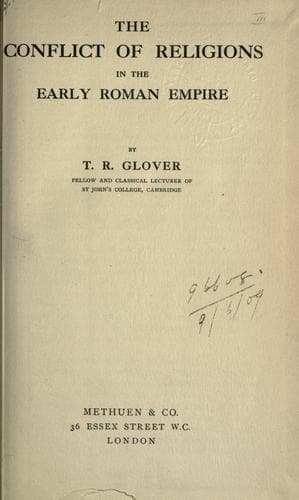
The Conflict of Religions in the Early Roman EmpireGlover, T. R. (Terrot Reaveley)
Religion
The Conflict of Religions in the Early Roman Empire
Glover, T. R. (Terrot Reaveley)
Christianity and other religions; Church history -- Primitive and early church, ca. 30-600; Rome -- Religion
Celsus forgot for the moment that the same sort of criticism had been
made upon Socrates. "'You had better be done,' said Critias, 'with
those shoemakers of yours, and the carpenters and coppersmiths. They
must be pretty well down at the heel by now--considering the way you
have talked them round.' 'Yes,' said Charicles, 'and the cowherds
too.'"[5] But six centuries had made another man of Socrates. His
ideas, interpreted by Plato and others, had altered the whole thinking
of the Greek world; his Silenus-face had grown beautiful by {118}
association; the physiognomy of his mind and speech was no longer so
striking; he was a familiar figure, and his words and phrases were
current coin, accepted without question. But to Celsus Jesus was no
such figure; he had not the traditions and preconceptions which have in
turn obscured for us the features of Jesus; there was nothing in Jesus
either hallowed or familiar, and one glance revealed a physiognomy.
That he did not like it is of less importance.
[Sidenote: The words of Jesus]
Taking the saying in question, we find, as Celsus did, absurdity upon
the face of it, and, as he also did, something else at the heart of
it--a contrast between surface and inner value broad as the gulf
between the common sense which men gather from experience and the
morality which Jesus read beneath human nature. Among the words of
Jesus there are many such sayings, and it is clear that he himself saw
and designed the contrasts which we feel as we read them. This sense
of contrast is one of the ground-factors of humour generally, perhaps
the one indispensable factor; it is always present in the highest
humour. If we then take the words of Jesus, as they struck those who
first heard them--or as they struck Celsus--we cannot help remarking at
once a strong individual character in them, one element in which is
humour,--always one of the most personal and individual of all marks of
physiognomy.
Public-domain text, read in full here on John Shaqi.
Reviews
Reviews
No reviews yet
Be the first to share your thoughts on this work.
Elsewhere in the archive
Join the Discussion
Join the discussion
Sign in to leave a comment or review.
Sign InorCreate an account