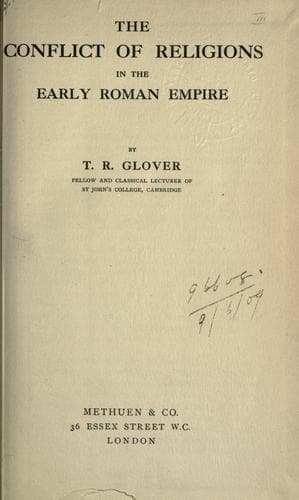
The Conflict of Religions in the Early Roman EmpireGlover, T. R. (Terrot Reaveley)
Religion
The Conflict of Religions in the Early Roman Empire
Glover, T. R. (Terrot Reaveley)
Christianity and other religions; Church history -- Primitive and early church, ca. 30-600; Rome -- Religion
showing, it is of importance to learn the mind of one whose speech is
so full of life, and it is happily possible to do this from even the
small collections we possess of his recorded sayings.
{120}
Quite apart from the human interest which always clings about the
childhood of a significant man, the early years of Jesus have a value
of their own, for it was to them that he always returned when he wished
to speak his deepest thought on the relations of God and man. In the
life and love of the home he found the truest picture of the divine
life. This we shall have to consider more fully at a later point.
Very little is said by the evangelists of the childhood and youth at
Nazareth, but in the parables we have Jesus' own reminiscences, and the
scenes and settings of the stories he tells fit in easily and
pleasantly with the framework of the historical and geographical facts
of his life at Nazareth.
The town lies in a basin among hills, from the rim of which can be seen
the historic plain of Esdraelon toward the South, Eastward the Jordan
valley and the hills of Gilead, and to the West the sea. "It is a map
of Old Testament history."[9] On great roads North and South of the
town's girdle of hills passed to and fro, on the journey between Egypt
and Mesopotamia, the many-coloured traffic of the East--moving no
faster than the camel cared to go, swinging disdainfully on, with
contempt on its curled lip for mankind, its work and itself. Traders,
pilgrims and princes--the kingdoms of the world and the glory of
them--all within reach and in no great hurry, a panorama of life for a
thoughtful and imaginative boy.
The history of his nation lay on the face of the land at his feet, and
it was in the North that the Zealots throve. Was it by accident that
Joseph the carpenter gave all his five sons names that stood for
something in Hebrew history? Jesus himself says very little, if
anything, of the past of his people, and he does not, like some of the
Psalmists, turn to the story of Israel for the proof of his thoughts
upon God. But it may be more than a coincidence that his countrymen
were impressed with his knowledge of the national literature; and
traces of other than canonical books have been found in his teaching.
It implies a home of piety, where God was in all their thoughts.
[Sidenote: His early life]
Public-domain text, read in full here on John Shaqi.
Reviews
Reviews
No reviews yet
Be the first to share your thoughts on this work.
Elsewhere in the archive
Join the Discussion
Join the discussion
Sign in to leave a comment or review.
Sign InorCreate an account