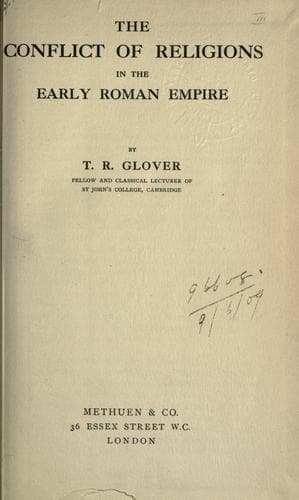
The Conflict of Religions in the Early Roman EmpireGlover, T. R. (Terrot Reaveley)
Religion
The Conflict of Religions in the Early Roman Empire
Glover, T. R. (Terrot Reaveley)
Christianity and other religions; Church history -- Primitive and early church, ca. 30-600; Rome -- Religion
Humour, in its highest form, is the sign of a mind at peace with
itself, for which the contrasts and contradictions of life have ceased
to jar, though they have not ceased to be,--which accepts them as
necessary and not without meaning, indeed as adding charm to life, when
they are viewed from above. It is the faculty which lets a man see
what Plato called "the whole tragedy and comedy of life"[6]--the one in
the other. Is it not humour that saw the Pharisee earnestly rinsing,
rubbing and polishing the _outside_ of his cup, forgetful of the fact
that he drank from the inside? that saw the simple-minded taking their
baskets to gather the grape-harvest from bramble-bushes? That pleaded
with a nation, already gaining a name for being sordid, _not_ to cast
pearls before swine, and to forsake caring for the morrow, because such
care was the mark of the Gentile world--the distinguishing sign between
Gentile and Jew? {119} That told the men he knew so well--men bred in
a rough world--to "turn the other cheek,"--to yield the cloak to him
who took the coat, not in irony, but with the brotherly feeling that
"his necessity is greater than mine"--to go when "commandeered" not the
required mile, making an enemy by sourness of face, but to go two--"two
additional," the Syriac version says--and so soften the man and make
him a friend?[7]
What stamps the language of Jesus invariably is its delicate ease,
implying a sensibility to every real aspect of the matter in hand--a
sense of mastery and peace. Men marvelled at the _charm_ of his
words--Luke using the Greek _charis_ to express it.[8] The homely
parable may be in other hands coarse enough, but the parables of Jesus
have a quality about them after all these years that leaves one certain
he smiled as he spoke them. There is something of the same kind to be
felt in Cowper's letters, but in the stronger nature the gift is of
more significance. At the cost of a little study of human character,
and close reading of the Synoptists, and some careful imagination, it
is possible to see him as he spoke,--the flash of the eye, the smile on
the lip, the gesture of the hand, all the natural expression of himself
and his thought that a man unconsciously gives in speaking, when he has
forgotten himself in his matter and his hearer--his physiognomy, in
fact. We realize very soon his complete mastery of the various aspects
of what he says. That he realizes every implication of his words is
less likely, for there is a spontaneity about them--they are "out of
the abundance of his heart"; the form is not studied; they are for the
man and the moment. But they imply the speaker and his whole relation
to God and man--they cannot help implying this, and that is their
charm. Living words, flashed out on the spur of the moment from the
depths of him, they _are_ the man. It was not idly that the early
church used to say "Remember the words of the Lord Jesus." On any
Public-domain text, read in full here on John Shaqi.
Reviews
Reviews
No reviews yet
Be the first to share your thoughts on this work.
Elsewhere in the archive
Join the Discussion
Join the discussion
Sign in to leave a comment or review.
Sign InorCreate an account