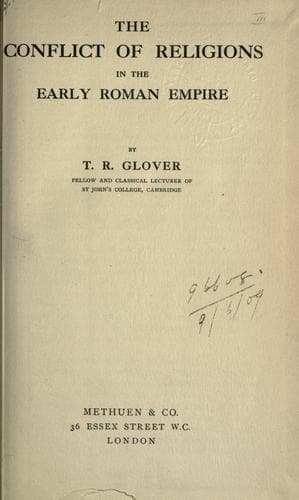
The Conflict of Religions in the Early Roman EmpireGlover, T. R. (Terrot Reaveley)
Religion
The Conflict of Religions in the Early Roman Empire
Glover, T. R. (Terrot Reaveley)
Christianity and other religions; Church history -- Primitive and early church, ca. 30-600; Rome -- Religion
Jesus had always a peculiar tenderness for children. "Suffer little
children to come unto me," is one of his most familiar sayings, though
in quoting it we are apt to forget that "come" is in Greek a verb
carrying volition with it, and that Mark uses another noticeable word,
and tells us that Jesus put his arms round the child.[12] Little
children, we may be sure, came to him of their own accord and were at
ease with him; {122} and it has been suggested that the saying goes
back to the Nazareth days, and that the little children came about
their brother in the workshop there. Mr Burkitt has recently
remarked[13] that we may read far and wide in Christian Literature
before we find any such feeling for children as we know so well in the
words of Jesus; and in Classical Literature we may look as far. To
Jesus the child is not unimportant--to injure a child was an
unspeakable thing. Indeed, if the Kingdom of God meant anything, it
was that we must be children again--God's little children, to whom
their Father is the background of everything. The Christian phrase
about being born again may be Jesus' own, but if so, it has lost for us
something of what he intended by it, which survives in more authentic
sayings. We have to recover, he said, what we lost when we outgrew the
child; we must have the simplicity and frankness of children--their
instinctive way of believing all things and hoping all things. All
things are new to the child; it is only for grown-up people that God
has to "_make_ all things new." Paul has not much to say about
children, but he has this thought--"if any man be in Christ, it is a
new creation, all things are made new." Probably the child's habit of
taking nothing for granted--except the love that is all about it--is
what Jesus missed most in grown men. Every idealist and every poet is
a child from beginning to end--and something of this sort is the mark
of the school of Jesus.
[Sidenote: Jesus and nature]
The outdoor life of Jesus lies recorded in his parables. Weinel has
said that Paul was a man of a city--Paul said so himself. But Jesus is
at home in the open air. The sights and sounds of the farm are in his
words--the lost sheep, the fallen ox, the worried flock, the hen
clucking to her chickens. This last gave a picture in which his
thought instinctively clothed itself in one of his hours of deepest
emotion. It is perhaps a mark of his race and land that to "feed
swine" is with him a symbol of a lost life, and that the dog is an
unclean animal--as it very generally is elsewhere. He speaks of
ploughing, clearly knowing how it should be done; and like other
teachers, he uses the analogies of sowing and harvest. The grain
growing secretly, and the harvest, over-ripe and spilling its wheat,
were to him pictures of human life.
{123}
Public-domain text, read in full here on John Shaqi.
Reviews
Reviews
No reviews yet
Be the first to share your thoughts on this work.
Elsewhere in the archive
Join the Discussion
Join the discussion
Sign in to leave a comment or review.
Sign InorCreate an account