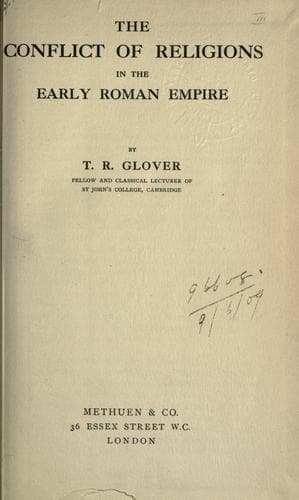
The Conflict of Religions in the Early Roman EmpireGlover, T. R. (Terrot Reaveley)
Religion
The Conflict of Religions in the Early Roman Empire
Glover, T. R. (Terrot Reaveley)
Christianity and other religions; Church history -- Primitive and early church, ca. 30-600; Rome -- Religion
Wild nature, too, he knew and loved. The wild lily, which the women
used to burn in their ovens never thinking of its beauty, was to him
something finer than King Solomon, and he probably had seen Herodian
princes on the Galilean roads. (It is a curious thing that he has more
than one allusion to royal draperies.) He bade men study the flowers
(_katamanthanein_). It is perhaps worth remark that flower-poetry came
into Greek literature from regions familiar to us in the life of Jesus;
Meleager was a Gadarene. The Psalmist long ago had said of the birds
that they had their meat from God; but Jesus brought them into the
human family--"Your Heavenly Father feedeth them." Even his knowledge
of weather signs is recorded. Not all flowers keep in literature the
scent and colour of life; they are a little apt to become "natural
objects." But if they are to retain their charm in print, something is
wanted that is not very common--the open heart and the open eye, to
which birds and flowers are willing to tell their secret. There are
other things which point to the fact that Jesus had this
endowment,--and not least his being able to find in the flower a link
so strong and so beautiful between God and man. Here as elsewhere he
was in touch with his environment, for he loved Nature as Nature, and
was true to it. His parables are not like AEsop's Fables. His lost
sheep has no arguments; his lily is not a Solomon, though it is better
dressed; and his sparrows are neither moralists nor theologians--but
sparrows, which might be sold at two for a farthing, and in the
meantime are chirping and nesting. And all this life of Nature spoke
to him of the character of God, of God's delight in beauty and God's
love. God is for him the ever-present thought in it all--real too, to
others, whenever he speaks of him.
Public-domain text, read in full here on John Shaqi.
Reviews
Reviews
No reviews yet
Be the first to share your thoughts on this work.
Elsewhere in the archive
Join the Discussion
Join the discussion
Sign in to leave a comment or review.
Sign InorCreate an account