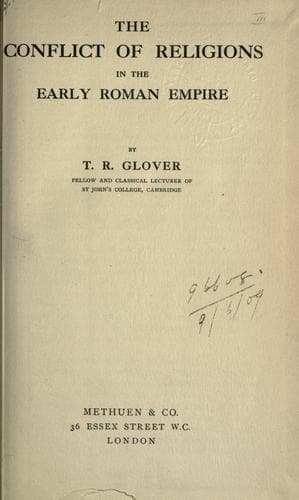
The Conflict of Religions in the Early Roman EmpireGlover, T. R. (Terrot Reaveley)
Religion
The Conflict of Religions in the Early Roman Empire
Glover, T. R. (Terrot Reaveley)
Christianity and other religions; Church history -- Primitive and early church, ca. 30-600; Rome -- Religion
The world in the age of Jesus was living a good deal upon its past,
looking to old books and old cults, as we see in Plutarch and many
others. The Jews no less lived upon their great books. Even Philo was
fettered to the Old Testament, {126} except when he could dissolve his
fetters by allegory, and even then he believed himself loyal to the
higher meaning of the text. But nothing of the kind is to be seen in
Jesus. His knowledge of Psalmist and Prophet excited wonder; but in
all his quotations of the Old Testament that have reached us, there is
no trace of servitude to the letter and no hint of allegory. He does
not quote Scripture as his followers did. Here too he spoke as having
authority. If sometimes he quoted words for their own sake, it was
always as an _argumentum ad hominem_. But his own way was to grasp the
writer's mind--a very difficult thing in his day, and little done--and
to go straight to the root of the matter, regardless of authority and
tradition. Like draws to like, and an intensely real man at once
grasped his kinship with other intensely real men; and he found in the
prophets, not reeds shaken with the wind, courtiers of king or of
people, but men in touch with reality, with their eyes open for God,
friends and fore-runners, whose experience illumined his own. This
type of manhood needed no explanation for him. The other sort
perplexed him--"Why can you not judge for yourselves?" how was it that
men could see and yet not see? From his inner sympathy with the
prophetic mind, came his freedom in dealing with the prophets. He read
and understood, and decided for himself. No sincere man would ever
wish his word to be final for another. Jesus was conscious of his own
right to think and to see and to judge, and for him, as for the modern
temper, the final thing was not opinion, nor scripture, nor authority,
but reality and experience. There lay the road to God. Hence it is
that Jesus is so tranquil,--he does "not strive nor cry"--for the man
who has experienced in himself the power of the real has no doubts
about it being able to maintain itself in a world, where at heart men
want nothing else.
[Sidenote: The temptations of Jesus]
Public-domain text, read in full here on John Shaqi.
Reviews
Reviews
No reviews yet
Be the first to share your thoughts on this work.
Elsewhere in the archive
Join the Discussion
Join the discussion
Sign in to leave a comment or review.
Sign InorCreate an account