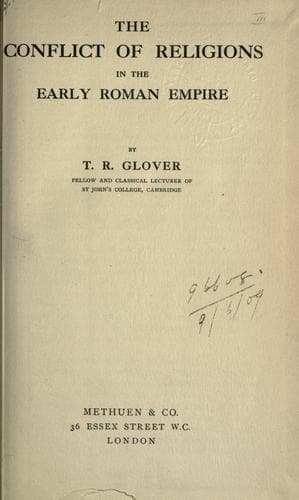
The Conflict of Religions in the Early Roman EmpireGlover, T. R. (Terrot Reaveley)
Religion
The Conflict of Religions in the Early Roman Empire
Glover, T. R. (Terrot Reaveley)
Christianity and other religions; Church history -- Primitive and early church, ca. 30-600; Rome -- Religion
Jesus had been bred in another atmosphere, in a school of realities.
When he said "Blessed are ye poor, for yours is the Kingdom of heaven,"
his words were the record of experience--the paradox was the story of
his life. He had known poverty and hand-labour; he had been "exposed
to feel what wretches feel." Whatever criticism may make of the story
of his feeding {125} multitudes, it remains that he was markedly
sensitive to the idea of hunger--over and over he urged the feeding of
the poor, the maimed and the blind; he suggested the payment of a day's
wage for an hour's work, where a day's food was needed and only an
hour's work could be had; he even reminded a too happy father that his
little girl would be the better of food. No thinker of his day, or for
long before and after, was so deeply conscious of the appeal of sheer
misery, and this is one of the things on which his followers have never
lost the mind of Jesus. Poverty was perhaps even for himself a key to
the door into the Kingdom of God. At any rate, he always emphasizes
the advantage of disadvantages, for they at least make a man in earnest
with himself.
There is a revelation of the seriousness of his whole mind and nature
in his reply to the follower who would go away and return. "No man,
having put his hand to the plough and looking back, is _fit_ for the
Kingdom of God." This every one knows who has tried to drive a furrow,
and all men of action know only too well that the man, whom Jesus so
describes, is fit for no kind of Kingdom. It is only the
sentimentalism of the church that supposes the flabby-minded to be at
home in the Kingdom of God. Jesus did not. The same kind of energy is
in the parables. The unjust steward was a knave, but he was in
earnest; and so was the questionably honest man who found treasure in a
field. The merchant let everything go for the one pearl of great
price. Mary chose "the one thing needful." We may be sure that in one
shop in Nazareth benches were made to stand on four feet and doors to
open and shut. The parables from nature, as we have seen, are true to
the facts of nature. They too stand on four feet. The church laid
hold of a characteristic word, when it adopted for all time Jesus'
_Amen_--"in truth." Jesus was always explicit with his followers--they
should know from the first that their goal was the cross, and that
meantime they would have no place where to lay their heads. They were
to begin with hard realities, and to consort with him on the basis of
the real.
Public-domain text, read in full here on John Shaqi.
Reviews
Reviews
No reviews yet
Be the first to share your thoughts on this work.
Elsewhere in the archive
Join the Discussion
Join the discussion
Sign in to leave a comment or review.
Sign InorCreate an account