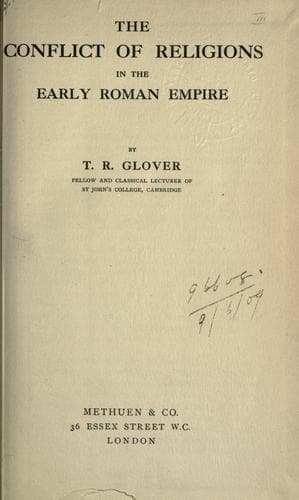
The Conflict of Religions in the Early Roman EmpireGlover, T. R. (Terrot Reaveley)
Religion
The Conflict of Religions in the Early Roman Empire
Glover, T. R. (Terrot Reaveley)
Christianity and other religions; Church history -- Primitive and early church, ca. 30-600; Rome -- Religion
atmosphere, but it was natural to him and he breathed it unconsciously.
The cultivation of likeness to God by Greek philosophers and their
pupils was very different. Plutarch has left a tract, kindly and
sensible, on "How a man may recognize his own progress in virtue," but
there is no native Christian product of the kind.
[Sidenote: The Kingdom of God]
From what Jesus directly says of God, and from what he says of God's
children, we may conclude that he classes God with the strong and sunny
natures; with the people of bright eyes who see through things and into
things, who have the feeling for reality, and love every aspect of the
real. God has that sense which is peculiar to the creative mind--the
keen joy {137} in beauty, that loves star and bird and child. God has
the father's instinct, a full understanding of human nature, and a
heart open for the prodigal son, the publican and the woman with seven
devils. "In his will is our peace," wrote the great Christian poet of
the middle ages. "Doing the will we find rest," said a humble and
forgotten Christian of the second century.[24] They both learnt the
thought from Jesus, who set it in the prayer beginning with _Abba_
which he taught his disciples, and who prayed it himself in the garden
with the same _Abba_ in his heart. "In the Lord's prayer," said
Tertullian, "there is an epitome of the whole Gospel."[25]
At this point two questions rise, which are of some historical
importance, and bear upon Jesus' view of God. It is clear, first of
all, that the expression "the Kingdom of God" was much upon the lips of
Jesus, at least in the earlier part of his ministry. It was not of his
own coining, and scholars have differed as to what he really meant.
Such controversy always rises about the terms in which a great mind
expresses itself. The great thinker, even the statesman, has to use
the best language he can find to convey his ideas, and if the ideas are
new, the difficulty of expression is sometimes very great. The words
imply one thing to the listener, and another to the speaker who is
really trying (as Diogenes put it) to "re-mint the currency," and how
far he succeeds depends mostly upon his personality. To-day "the
Kingdom," or more accurately "the Kingship of God," is in some quarters
interpreted rather vigorously in the sense which the ordinary Jew gave
to the phrase in the age of Jesus; but it is more than usually unsound
criticism to take the words of such a man as meaning merely what they
would in the common talk of unreflective persons, who use words as
counters and nothing else. There was a vulgar interpretation of the
"Kingship of God," and there was a higher one, current among the better
spirits; and it is only reasonable to interpret this phrase, or any
other, in the light of the total mind of the man who uses it. It is
clear then that, when Jesus used "the Kingship of God," he must have
subordinated it to his general idea of God; and what {138} that was, we
have seen.
Public-domain text, read in full here on John Shaqi.
Reviews
Reviews
No reviews yet
Be the first to share your thoughts on this work.
Elsewhere in the archive
Join the Discussion
Join the discussion
Sign in to leave a comment or review.
Sign InorCreate an account