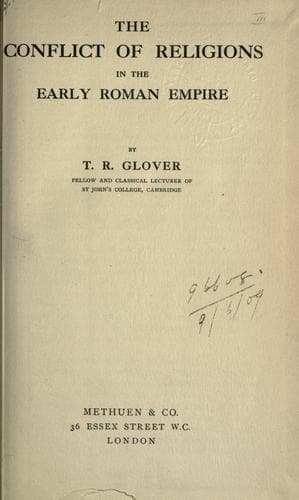
The Conflict of Religions in the Early Roman EmpireGlover, T. R. (Terrot Reaveley)
Religion
The Conflict of Religions in the Early Roman Empire
Glover, T. R. (Terrot Reaveley)
Christianity and other religions; Church history -- Primitive and early church, ca. 30-600; Rome -- Religion
Plato had long before defined the object of human life as "becoming
like to God." Jesus finds the means to this likeness to God in the
simplest of every day's opportunities. "Love your enemies and do good,
and ye shall be sons of the Highest, for he is good and pitiful."
"Blessed are the peace-makers," he said, "for they shall be called
children of God." This is sometimes limited to the reconciliation of
quarrels, but the worst of quarrels is the rift in a man's own soul,
the "division of his spiritual substance against itself" which is the
essence of all tragedy. There are some whose least word, or whose
momentary presence, can somehow make peace wherever they go, and leave
men stronger for the rest they have found in another's soul. This,
according to Jesus, is the family likeness by which God's children are
recognized in all sorts of company. To have the faculty of
communicating peace of mind--and it is more often than not done
unconsciously, as most great things are--is no light or accidental gift.
Jesus lays a good deal more stress upon unconscious instinct than most
moralists do. Once only he is reported to have spoken of the Last
Judgment, which was a favourite theme {136} with the eschatologists of
his period, Jewish, pagan, and Christian. He borrowed the whole
framework of the scene, but he changed, and doubly changed, the
significance of it. For he discarded the national or political
criterion which the Jew preferred, and he did not have recourse to the
rather individualistic moral test which Greek thinkers proposed, in
imitation of Plato; still less did it occur to him to suggest a
_Credo_. With him the ultimate standard was one of sheer kindness and
good-heartedness--"inasmuch as ye did it to one of the least of these
my brethren." But it is still more interesting to note how this
standard is applied. Every one at the Last Judgment accepts it, just
as every one accepts the propositions of moralists in general. But the
real cleavage between the classes of men does not depend on morality,
as the chilly suggestion of the mere word reminds us. Men judge other
men not by their morality, professed or practised, so much as by their
unconscious selves--by instinct, impulse and so forth, the things that
really give a clue to the innermost man. The most noticeable point
then in Jesus' picture of the Last Judgment is that, when "sheep" and
"goats" are separated, neither party at once understands the reasons of
the decision. These are conscious of duties done; the others have no
very clear idea about it. Elsewhere Jesus suggests that, when men have
done all required of them, they may still have the feeling that they
are unprofitable servants; and it is precisely the peace-makers and the
pure in heart who do not realize how near they come to God. The priest
and the Levite in the parable were conscious of their purity, but Jesus
gives no hint that they saw God. The Samaritan lived in another
Public-domain text, read in full here on John Shaqi.
Reviews
Reviews
No reviews yet
Be the first to share your thoughts on this work.
Elsewhere in the archive
Join the Discussion
Join the discussion
Sign in to leave a comment or review.
Sign InorCreate an account