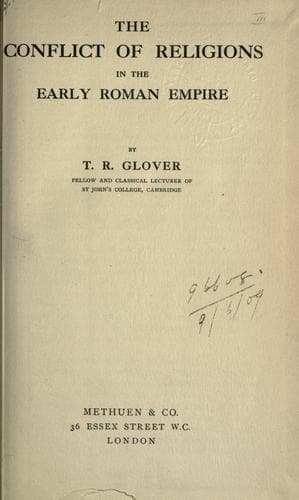
The Conflict of Religions in the Early Roman EmpireGlover, T. R. (Terrot Reaveley)
Religion
The Conflict of Religions in the Early Roman Empire
Glover, T. R. (Terrot Reaveley)
Christianity and other religions; Church history -- Primitive and early church, ca. 30-600; Rome -- Religion
Holy wells too were common, which were honoured with models of the
limbs their waters healed, and other curious gifts, thrown into
them--as they are still in every part of the Old World. Horace's fount
of Bandusia is the most famous of these in literature.[41] It was an
old usage to throw garlands into springs and to crown wells on October
13th.[42] Streams and {14} wells alike were haunted by mysterious
powers, too often malevolent.[43]
Ovid describes old charms to keep off vampires, _striges_, from the
cradles of children.[44]
In fact the whole of Nature teemed with beings whom we find it hard to
name. They were not pleasant enough, and did not appeal enough to the
fancy, to merit the name "fairies"--at least since _The Midsummer
Night's Dream_ was written. Perhaps they are nearer "The little
People"--the nameless "thim ones."[45] They were neither gods nor
demons in our sense of the words, though Greek thinkers used the old
Homeric word _daimon_ to describe them or the diminutive of it, which
allowed them to suppose that Socrates' _daimonion_ was something of the
kind.
[Sidenote: The genius]
But these Nature-spirits, whatever we may call them, were far from
being the only superhuman beings that encompassed man. Every house had
its _Lares_ in a little shrine (_lararium_) on the hearth, little twin
guardian gods with a dog at their feet, who watched over the family,
and to whom something was given at every meal, and garlands on great
days. Legend said that Servius Tullius was the son of the family
_Lar_.[46] The _Lares_ may have been spirits of ancestors. The
Emperor Alexander Severus set images of Apollonius, Christ, Abraham and
Orpheus, "and others of that sort" in his _lararium_.[47] Not only
houses but streets and cross-roads had _Lares_; the city had a
thousand, Ovid said, besides the _genius_ of the Prince who gave
them;[48] for Augustus restored two yearly festivals in their honour in
Spring and Autumn. There were also the _Penates_ in every home, whom
it would perhaps be hard to distinguish very clearly from the _Lares_.
Horace has a graceful ode to "Phidyle" on the sufficiency of the
simplest sacrifices to these little gods of home and hearth.[49] The
worship of these family gods was almost the only {15} part of Roman
religion that was not flooded and obscured by the inrush of Oriental
cults.
"The Ancients," said Servius, "used the name _Genius_ for the natural
god of each individual place or thing or man,"[50] and another
antiquary thought that the _genius_ and the _Lar_ might be the same
thing. For some reason men of letters laid hold upon the _genius_, and
we find it everywhere. Why there should be such difference even
between twin brothers,
_He_ only knows whose influence at our birth
O'errules each mortal's planet upon earth,
The attendant genius, temper-moulding pow'r,
That stamps the colour of man's natal hour.[51]
Public-domain text, read in full here on John Shaqi.
Reviews
Reviews
No reviews yet
Be the first to share your thoughts on this work.
Join the Discussion
Join the discussion
Sign in to leave a comment or review.
Sign InorCreate an account