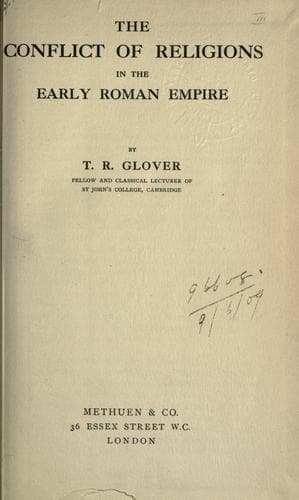
The Conflict of Religions in the Early Roman EmpireGlover, T. R. (Terrot Reaveley)
Religion
The Conflict of Religions in the Early Roman Empire
Glover, T. R. (Terrot Reaveley)
Christianity and other religions; Church history -- Primitive and early church, ca. 30-600; Rome -- Religion
What was written in the Gospels of the life and death of Jesus, might
by now be ancient history, if the Gospels had told the whole story.
But they did not tell the whole story; and they neither were, nor are,
the source of the Christian movement, great as their influence is and
has been. The Jesus who has impressed himself upon mankind is not a
character, however strong and beautiful, that is to be read about in a
book. Before the Gospels were written, men spoke of the "Spirit of
Jesus" as an active force amongst them. We may criticize their phrase
and their psychology as we like, but they were speaking of something
they knew, something they had seen {140} and felt, and it is that
"something" which changed the course of history. Jesus lives for us in
the pages of the Gospels, but we are not his followers on that account,
nor were the Christians of the first century. They, like ourselves,
followed him under the irresistible attraction of his character
repeating itself in the lives of men and women whom they knew. The Son
of God, they said, revealed himself in men, and it was true. Of his
immediate followers we know almost nothing, but it was they who passed
him on to the next generation, consciously in their preaching, which
was not always very good; and unconsciously in their lives, which he
had transformed, and which had gained from him something of the power
of his own life. The church was a nexus of quickened and redeemed
personalities,--men and women in whom Christ lived. So Paul wrote of
it. A century later another nameless Christian spoke of Christ being
"new born every day over again in the hearts of believers," and it
would be hard to correct the statement. If we are to give a true
account of such men as Alexander and Caesar, we consider them in the
light of the centuries through which their ideas lived and worked. In
the same way, the life, the mind and the personality of Jesus will not
be understood till we have realized by some intimate experience
something of the worth and beauty of the countless souls that in every
century have found and still find in him the Alpha and Omega of their
being. For the Gospels are not four but "ten thousand times ten
thousand, and thousands of thousands," and the last word of every one
of them is "Lo, I am with you alway, even unto the end of the world."
Chapter IV Footnotes:
[1] Justin, _Apology_, i, 66.
[2] Quoted by Origen, _contra Celsum_, ii, 26, 27.
[3] Cf. Mr F. C. Conybeare's article on the remodelling of the
baptismal formula in Matthew xxviii after the Council of Nicaea,
_Hibbert Journal_, Oct. 1902.
[4] Origen, _c. Cels._ vii, 58, _agroikoteron_.
[5] Xen. _Mem_, i, 2, 37. Cf. Plato, _Symp._ 221 E. Gorgias, 491 A.
See Forbes, _Socrates_, 128; Adam, _Religious Teachers of Greece_, i,
338.
[6] Plato, _Philebus_, 50 B.
Public-domain text, read in full here on John Shaqi.
Reviews
Reviews
No reviews yet
Be the first to share your thoughts on this work.
Elsewhere in the archive
Join the Discussion
Join the discussion
Sign in to leave a comment or review.
Sign InorCreate an account