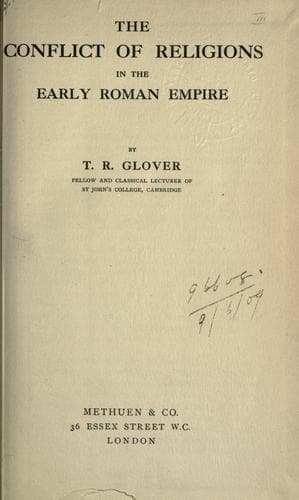
The Conflict of Religions in the Early Roman EmpireGlover, T. R. (Terrot Reaveley)
Religion
The Conflict of Religions in the Early Roman Empire
Glover, T. R. (Terrot Reaveley)
Christianity and other religions; Church history -- Primitive and early church, ca. 30-600; Rome -- Religion
Seneca and the Stoics played with the fancy of man's being equal, or in
some points superior, to God--a folly impossible for a Jewish mind. It
was the Jews who gave the world the "oracles of God" in the Old
Testament, who invested Christianity for the moment with the dignity of
an ancient history and endowed it for all time with a unique
inheritance of religious experience. Nor is it only the Old Testament
that the church owes to the Jew; for the Gospels are also his
gift--anchors in the actual that have saved Christianity from all kinds
of intellectual, spiritual and ecclesiastical perils. And, further, at
the difficult moment of transition, when Christian ideas passed from
the Jewish to the Gentile world, there were Jews of the Hellenistic
type ready to mediate the change. They of all men stood most clearly
at the universal point of view; they knew the grandeur and the weakness
of the law; they understood at once the Jewish and the Greek mind. It
is hard to exaggerate what Christianity owes to men of this school--to
Paul and to "John," and to a host of others, Christian Jews of the
Dispersion, students of Philo, and followers of Jesus. On Jewish soil
the new faith died; it was transplantation alone that made Christianity
possible; for it was the true outcome of the teaching of Jesus, that
the new faith should be universal.
The chief contribution of the Greek was his demand for this very
thing--that Christianity must be universal. He made no secret of his
contempt for Judaism, and he was emphatic in insisting on a larger
outlook than the Jewish. No man could seem more naturally unlikely to
welcome the thoughts of Jesus than the "little Greek" (_Graaeculus_) of
the Roman world; yet he was won; and then by making it impossible for
Christianity to remain an amalgam of the ideas of Jesus and of Jewish
law, {145} the Greek really secured the triumph of Jesus. He
eliminated the tribal and the temporary in the Gospel as it came from
purely Jewish teachers, and, with all his irregularities of conduct and
his flightiness of thought, he nevertheless set Jesus before the world
as the central figure of all history and of all existence.[7] Even the
faults of the Greek have indirectly served the church; for the Gospels
gained their place in men's minds and hearts, because they were the
real refuge from the vagaries of Greek speculation, and offered the
ultimate means of verifying every hypothesis. The historic Jesus is
never of such consequence to us as when the great intellects tell us
that the true and only heaven is Nephelococcygia. For Aristophanes was
right--it was the real Paradise of the Greek mind. What relief the
plain matter-of-fact Gospel must have brought men in a world, where
nothing throve like these cities of the clouds, would be inconceivable,
if we did not know its value still. While we recognize the real
contribution of the Greek Christians, it is good to see what
Christianity meant to men who were not Greeks.
Public-domain text, read in full here on John Shaqi.
Reviews
Reviews
No reviews yet
Be the first to share your thoughts on this work.
Elsewhere in the archive
Join the Discussion
Join the discussion
Sign in to leave a comment or review.
Sign InorCreate an account