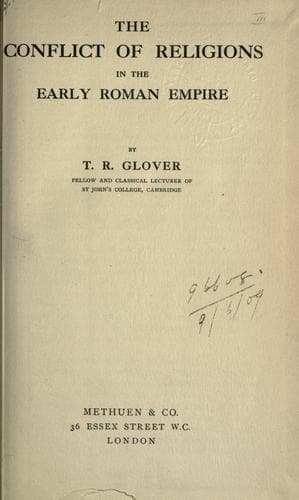
The Conflict of Religions in the Early Roman EmpireGlover, T. R. (Terrot Reaveley)
Religion
The Conflict of Religions in the Early Roman Empire
Glover, T. R. (Terrot Reaveley)
Christianity and other religions; Church history -- Primitive and early church, ca. 30-600; Rome -- Religion
[Sidenote: Tatian]
There was one Christian of some note in the second century, whose
attitude toward everything Greek is original and interesting. Tatian
was "born in the land of the Assyrians."[8] He travelled widely in the
Graeco-Roman world,[9] and studied rhetoric like a Greek; he gave
attention to the great collections of Greek art in Rome--monuments of
shame, he called them. He was admitted to the mysteries, but he became
shocked at the cruelty and licentiousness tolerated and encouraged by
paganism. While in this mind, seeking for the truth, "it befel that I
lit upon some barbarian writings, older than the dogmata of the Greeks,
divine in their contrast with Greek error; and it befel too that I was
convinced by them, because, their style was simple, because there was
an absence of artifice in the speakers, because the structure of the
whole was intelligible, and also because of the fore-knowledge of
future {146} events, the excellence of the precepts and the
subordination of the whole universe to One Ruler (_to ton holon
monarchikon_). My soul was taught of God, and I understood that while
Greek literature (_ta men_) leads to condemnation, this ends our
slavery in the world and rescues us from rulers manifold and ten
thousand tyrants."[10] He now repudiated the Greeks and all their
works, the grammarians who "set the letters of the alphabet to quarrel
among themselves,"[11] the philosophers with their long hair and long
nails and vanity,[12] the actors, poets and legislators; and "saying
good-bye to Roman pride and Attic pedantry (_psychrologia_) I laid hold
of our barbarian philosophy."[13] He made the first harmony of the
Gospels--an early witness to the power of their sheer simplicity in a
world of literary affectations.
Another famous Syrian of the century was Ignatius of Antioch, whose
story is collected from seven letters he wrote, in haste and
excitement, as he travelled to Rome to be thrown to the beasts in the
arena--his guards in the meantime being as fierce as any leopards. The
burden of them all is that Jesus Christ _truly_ suffered on the cross.
Men around him spoke of a phantom crucified by the deluded soldiers
amid the deluded Jews.--No! cries Ignatius, over and over, he _truly_
suffered, he _truly_ rose, ate and drank, and was no daemon without a
body (_daimonion asomaton_)--none of it is _seeming_, it is all truly,
truly, truly.[14] He has been called hysterical, and his position
might make any nervous man hysterical--death before him, his Lord's
reality denied, and only time for one word--_Truly_. Before we pass
him by, let us take a quieter saying of his to illustrate the deepest
thought of himself and his age--"He that hath the word of Jesus truly
can hear his silence also."[15]
Public-domain text, read in full here on John Shaqi.
Reviews
Reviews
No reviews yet
Be the first to share your thoughts on this work.
Elsewhere in the archive
Join the Discussion
Join the discussion
Sign in to leave a comment or review.
Sign InorCreate an account