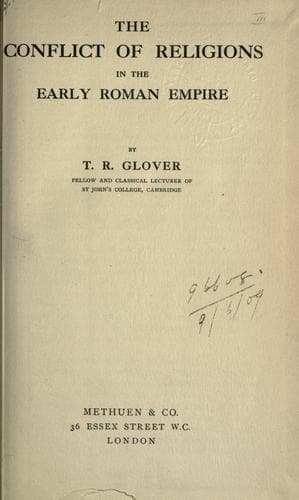
The Conflict of Religions in the Early Roman EmpireGlover, T. R. (Terrot Reaveley)
Religion
The Conflict of Religions in the Early Roman Empire
Glover, T. R. (Terrot Reaveley)
Christianity and other religions; Church history -- Primitive and early church, ca. 30-600; Rome -- Religion
The Roman came to the Church as he came to a new province. He gravely
surveyed the situation, considered the existing arrangements, accepted
them, drew up as it were a _lex provinciae_ to secure their proper
administration, and thereafter interpreted it in accordance with the
usual principles of Roman {147} law, and, like the procurator in Achaea,
left the Greeks to discuss any abstract propositions they pleased.
Tertullian and Cyprian were lawyers, and gave Latin Christendom the
language, in which in later days the relations of man with his Divine
Sovereign were worked out by the great Latin Fathers.
[Sidenote: Freedom from daemons]
The confession of Tatian, above cited, emphasizes as one of the great
features of the barbarian literature--its "monarchic" teaching--"it
sets man free from ten thousand tyrants"--and this may be our
starting-point in considering the new experience. To be rid of the
whole daemon-world, to have left the daemons behind and their "hatred of
men,"[16] their astrology,[17] their immorality and cruelty, their
sacrifices, and the terror of "possession" and theolepsy and
enchantment,[18] was happiness in itself. "We are above fate," said
Tatian, "and, instead of daemons that deceive, we have learnt one master
who deceiveth not."[19] "Christ," wrote an unknown Christian of a
beautiful spirit--"Christ wished to save the perishing, and such mercy
has he shown us that we the living do not serve dead gods, but through
him we know the Father of truth."[20] "Orpheus sang to beguile men,
but my Singer has come to end the tyranny of daemons," said Clement.[21]
The perils of "meats offered to idols" impressed some, who feared that
by eating of them they would come under daemoniac influence. With what
relief they must have read Paul's free speech on the subject--"the
earth is the Lord's and the fullness thereof"--"for us there is one
God, the Father, and one Lord, Jesus Christ, through whom are all
things, and we through him."[22] "Even the very name of Jesus is
terrible to the daemons"[23]--the "name that is above every name." In
no other name was there salvation from daemons, for philosophy had made
terms with them.
Public-domain text, read in full here on John Shaqi.
Reviews
Reviews
No reviews yet
Be the first to share your thoughts on this work.
Elsewhere in the archive
Join the Discussion
Join the discussion
Sign in to leave a comment or review.
Sign InorCreate an account