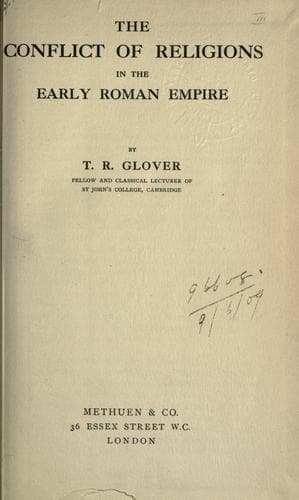
The Conflict of Religions in the Early Roman EmpireGlover, T. R. (Terrot Reaveley)
Religion
The Conflict of Religions in the Early Roman Empire
Glover, T. R. (Terrot Reaveley)
Christianity and other religions; Church history -- Primitive and early church, ca. 30-600; Rome -- Religion
But it is one thing to be a monotheist, and another to be a child of
"Abba Father," and this is one of the notes of the early Christian. It
is impossible to over-emphasize the significance of Christian happiness
amid the strain and doubt of the early Empire. Zeno and Isis each had
something to say, but who had such a message of forgiveness and
reconciliation and of the love of God? "God is within you," said
Seneca; but he knew nothing of such an experience as the Christian
summed up as the "grace of God," "grace sufficient" and "grace {149}
abounding." It is hard to think of these familiar phrases being new
and strange--the coining of Paul to express what no man had said
before--and this at the moment when Seneca was writing his "moral
letters" to Lucilius. Verbal coincidences may be found between Paul
and Seneca, but they are essentially verbal. The Stoic Spermaticos
Logos was a cold and uninspiring dogma compared with "Abba Father" and
the Spirit of Jesus--it was not the same thing at all. The one
doctrine made man self-sufficient--in the other, "our sufficiency
(_hikanotes_) is of God." It was the law of nature, contrasted with the
father of the prodigal son--"our kind and tender-hearted father" as
Clement of Rome calls him [27]--the personal God, whose "problem is
ever to save the flock of men; that is why the good God has sent the
good shepherd."[28]
The more lettered of Christian writers like to quote Plato's saying
that man was born to be at home with God (_oikeios echein pros theon_)
and that he was "a heavenly plant." Falsehood, they say, and error
obscured all this, but now "that ancient natural fellowship with
heaven" has "leapt forth from the darkness and beams upon us."[29]
"God," says Clement, "out of his great love for men, cleaves to man,
and as when a little bird has fallen out of the nest, the mother-bird
hovers over it, and if perchance some creeping beast open its mouth
upon the little thing,
Wheeling o'er his head, with screams the dam
Bewails her darling brood;
so God the Father seeks his image, and heals the fall, and chases away
the beast, and picks up the little one again."[30]
Public-domain text, read in full here on John Shaqi.
Reviews
Reviews
No reviews yet
Be the first to share your thoughts on this work.
Elsewhere in the archive
Join the Discussion
Join the discussion
Sign in to leave a comment or review.
Sign InorCreate an account