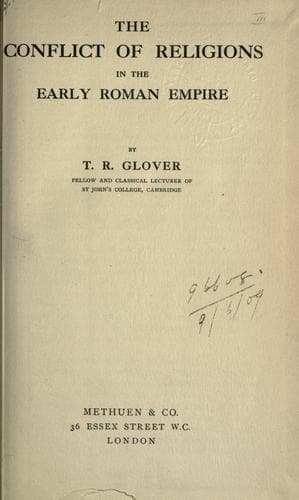
The Conflict of Religions in the Early Roman EmpireGlover, T. R. (Terrot Reaveley)
Religion
The Conflict of Religions in the Early Roman Empire
Glover, T. R. (Terrot Reaveley)
Christianity and other religions; Church history -- Primitive and early church, ca. 30-600; Rome -- Religion
Freedom from daemons, forgiveness and reconciliation with God, gladness
and moral strength and peace in the holy spirit--of such things the
early Christians speak, and they associate them all invariably with one
name, the living centre of all. "Jesus the beloved" is a phrase that
lights up one of the dullest of early Christian pages.[33] "No! you do
not so much as listen to anyone, if he speaks of anything but Jesus
Christ in truth," says Ignatius.[34] "What can we give him in return?
He gave us light ... he saved us when we were perishing ... We were
lame in understanding, and worshipped stone and wood, the works of men.
Our whole life was nothing but death.... He pitied us, he had
compassion, he saved us, for he saw we had no hope of salvation except
from him; he called us when we were not, and from not being he willed
us to be."[35] "The blood of Jesus, shed for our salvation, has brought
to all the world the grace of repentance."[36] "Ye see what is the
pattern that has been given us; what should we do who by him have come
under the yoke of his grace?"[37] "Let us be earnest to be imitators
of the Lord."[38] These are a few words from Christians whose writings
are not in the canon. Jesus is pre-eminently and always the Saviour;
the author of the new life; the revealer of God; the bringer of
immortality. It made an immense impression upon the ancient world to
see the transformation of those whom it despised,--women, artisans,
slaves and even slave-girls. Socrates with the hemlock cup and the
brave Thrasea were figures that men loved and honoured. But here were
all sorts of common people doing the same thing as Socrates and
Thrasea, cheerfully facing torture and death "for the name's sake"--and
it was a name of contempt, too. "Christ's people"--_Christianoi_--was
a bantering improvisation by the people of Antioch, who were notorious
in antiquity for impudent wit:[39] it was a happy shot {152} and
touched the very centre of the target. "The name" and "his name," are
constantly recurring phrases. But it was not only that men would die
for the name--men will die for anything that touches their imagination
or their sympathy--but they lived for it and showed themselves to be
indeed a "new creation." "Our Jesus"[40] was the author of a new life,
and a very different one from that of Hellenistic cities. That
Christianity retained its own character in the face of the most
desperate efforts of its friends to turn it into a philosophy congenial
to the philosophies of the day, was the result of the strong hold it
had taken upon innumerable simple people, who had found in it the power
of God in the transformation of their own characters and instincts, and
who clung to Jesus Christ--to the great objective facts of his
incarnation and his death upon the cross--as the firm foundations laid
in the rock against which the floods of theory might beat in vain. For
now we have to consider another side of early Christian activity--the
Public-domain text, read in full here on John Shaqi.
Reviews
Reviews
No reviews yet
Be the first to share your thoughts on this work.
Elsewhere in the archive
Join the Discussion
Join the discussion
Sign in to leave a comment or review.
Sign InorCreate an account