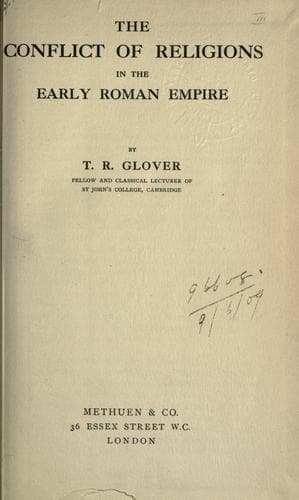
The Conflict of Religions in the Early Roman EmpireGlover, T. R. (Terrot Reaveley)
Religion
The Conflict of Religions in the Early Roman Empire
Glover, T. R. (Terrot Reaveley)
Christianity and other religions; Church history -- Primitive and early church, ca. 30-600; Rome -- Religion
explanation of the new experience.
The early Christian community found "the unexamined life" as impossible
as Plato had, and they framed all sorts of theories to account for the
change in themselves. Of most immediate interest are the accounts
which they give of the holy spirit and of Jesus. Here we must remember
that in all definition we try to express the less known through the
more known, and that the early Christians necessarily used the best
language available to them, and tried to communicate a new series of
experiences by means of the terms and preconceptions of the thinking
world of their day--terms and preconceptions long since obsolete.
Much in the early centuries of our era is unintelligible until we form
some notion of the current belief in spiritual beings, evidence of
which is found in abundance in the literature of the day, pagan and
Christian. A growing consensus among philosophers made God more and
more remote, and emphasized the necessity for intermediaries. We have
seen how Plutarch pronounced for the delegation of rule over the
universe and its functions to ministering spirits. The Jews had a
parallel belief in angels, and had come to think of God's spirit and
God's intelligence as somehow detachable from his being. In abstract
{153} thought this may be possible just as we think of an angle without
reference to matter. The great weakness in the speculation of the
early Empire was this habit of supposing that men can be as certain of
their deductions as of their premisses; and God's Logos, being
conceivable, passed into common religious thought as a separate and
proven existence.
[Sidenote: The holy spirit]
At the same time there was abundant evidence of devil-possession as
there is in China to-day. Modern medicine distinguishes four classes
of cases which the ancients (and their modern followers) group under
this one head:--Insanity, Epilepsy, Hysteria major and the mystical
state. To men who had no knowledge of modern medicine and its
distinctions, the evidence of the "possessed" was enough, and it was
apt to be quite clear and emphatic as it is in such cases to-day. The
man said he "had a devil"--or even a "legion of devils." The priestess
at the oracle said that a god was within her (_entheos_). In both
cases the ocular evidence was enough to convince the onlookers of the
truth of the explanation, for the persons concerned were clearly
changed and were not themselves.[41] Plato played with the idea that
poetry even might be, as poets said, a matter of inspiration. The poet
could not be merely himself when he wrote or sang words of such
transforming power. The Jews gave a similar account of prophecy--the
Spirit of the Lord descended upon men, as we read in the Old Testament.
The Spirit, says Athenagoras to the Greeks, used the Hebrew prophets,
as a flute-player does a flute, while they were in ecstasy (_kat
ekstasin_)[42]--the holy spirit, he adds, is an effluence (_aporroia_)
of God.[43]
Public-domain text, read in full here on John Shaqi.
Reviews
Reviews
No reviews yet
Be the first to share your thoughts on this work.
Elsewhere in the archive
Join the Discussion
Join the discussion
Sign in to leave a comment or review.
Sign InorCreate an account