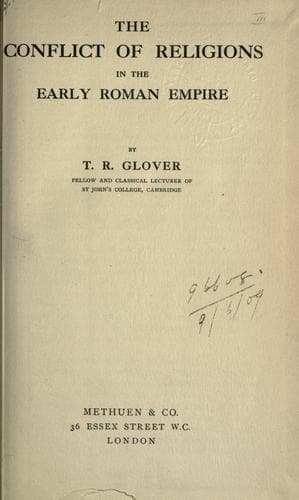
The Conflict of Religions in the Early Roman EmpireGlover, T. R. (Terrot Reaveley)
Religion
The Conflict of Religions in the Early Roman Empire
Glover, T. R. (Terrot Reaveley)
Christianity and other religions; Church history -- Primitive and early church, ca. 30-600; Rome -- Religion
Surveying the two accounts, Jewish and Greek, we cannot help remarking
that they belong to other ages of thought than our own. Columbus,
Copernicus and Darwin were neither philosophers nor theologians, but
they have changed the perspectives of philosophy and theology, and we
think to-day with a totally different series of preconceptions from
those of Jew and Greek of the first century. The Greek himself never
thought much of the "chosen race," and it was only when he realized
that Jesus was not a tribal hero, that he accepted him. To the Greek
the Messiah was as strange a thought as to ourselves. To us the Logos
is as strange as the Messiah was to the Greek. We have really at
present no terms in which to express what we feel to be the permanent
significance of Jesus, and the old expressions may repel us until we
realize, first, that they are not of the original essence of the
Gospel, and second, that they represent the best language which Greek
and Jew could find for a conviction which we share--that Jesus of
Nazareth does stand in the centre of human history, that he has brought
God and man into a new relation, that he is the personal concern of
everyone of us, and that there is more in him than we have yet
accounted for.
Into the question of the organization adopted by the early Christians
and the development of the idea of the church, it is not essential to
our present purpose to inquire. Opinion varies as to how far we should
seek the origin of the church in the teaching and work of Jesus. If
his mind has been at all rightly represented in this book, it seems to
follow that he was not responsible either for the name or the idea of
the church. Minds of the class to which his belongs have as a rule
little or no interest in organizations and arrangements, and nothing
can {158} be more alien to the tone and spirit of his thinking than the
ecclesiastical idea as represented by Cyprian and Ignatius. That out
of the group of followers who lived with Jesus, a society should grow,
is natural; and societies instinctively organize themselves. The Jew
offered the pattern of a theocracy, and the Roman of a hierarchy of
officials, but it took two centuries to produce the church of Cyprian.
The series of running fights with Greek speculation in the second
century contributed to the natural and acquired instincts for order and
system,--particularly in a world where such instincts had little
opportunity of exercise in municipal, and less in political, life. The
name was, as Harnack says, a masterly stroke--the "ecclesia of God"
suggested to the Greek the noble and free life of a self-governing
organism such as the ancient world had known, but raised to a higher
plane and transfigured from a Periclean Athens to a Heavenly Jerusalem.
Fine conceptions and high ideals clung about the idea of the church in
the best minds,[48] but in practice it meant the transformation of the
gospel into a code, the repression of liberty of thought, and the final
Public-domain text, read in full here on John Shaqi.
Reviews
Reviews
No reviews yet
Be the first to share your thoughts on this work.
Elsewhere in the archive
Join the Discussion
Join the discussion
Sign in to leave a comment or review.
Sign InorCreate an account