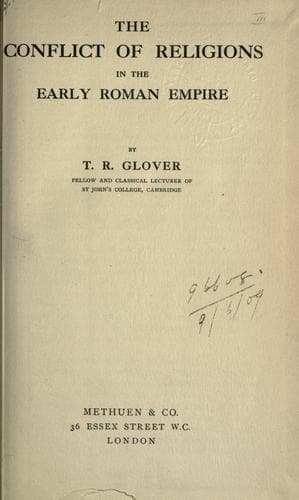
The Conflict of Religions in the Early Roman EmpireGlover, T. R. (Terrot Reaveley)
Religion
The Conflict of Religions in the Early Roman Empire
Glover, T. R. (Terrot Reaveley)
Christianity and other religions; Church history -- Primitive and early church, ca. 30-600; Rome -- Religion
Paul went back to the Jewish conception of a Messiah, modified, in the
real spirit of Jesus, by the thought of suffering. But when we put
side by side the Messiah of Jesus and the Messiah of Paul, we become
conscious of a difference. The latter is a mediator between God and
man, making atonement, transferring righteousness by a sort of legal
fiction, and implying a conception of God's fatherhood far below that
taught by Jesus. At the same time Paul has other thoughts of a
profounder and more permanent value. It is hard, for instance, to
imagine that any change, which time and thought may bring, can alter a
word in his statement that "God was in Christ, reconciling the world to
himself"--here there is no local or temporal element even in the
wording. It may be noted that Paul has his own names for Jesus, for
while he uses "Messiah" (in Greek) and "Son of God," he is the first to
speak of "the Lord" and "the Saviour." Paul held the door open for the
other great theory of the early church, when he emphasized the
pre-existence of the heavenly Christ and made him the beginning, the
centre and the end of all history.
The Logos, as we have seen, was not an original idea of the Christian
world. It was long familiar to Greek philosophy, and Philo and the
Stoics base much of their thought upon it. It must have come into the
church from a Greek or Hellenistic source, perhaps as a translation of
Paul's "heavenly Christ." As it stands, it is a peculiarly bold
annexation from Philosophy. No Stoic would have denied that the
Spermaticos Logos was in Jesus, but the bold identification of the
Logos with Jesus must have been "foolishness to the Greek." Still in
contemporary thought there was much to dispose men to believe in such
an incarnation of the Logos in a human being, though there is no
suggestion that a spiritual being of any at all commensurate {157}
greatness was ever so incarnated before. But the thought appealed to
the Christian mind, when once the shock to Greek susceptibilities was
overcome. Once accepted, it "solved all questions in the earth and out
of it." It permitted the congenial idea of Greek theology to
remain--the transcendence of God being saved by this personification of
his Thought. It was a final blow to all theories that made Jesus an
emanation, a phantom or a demi-god, and it kept his historic
personality well in the centre of thought, though leaving it now
comparatively much less significance.
Public-domain text, read in full here on John Shaqi.
Reviews
Reviews
No reviews yet
Be the first to share your thoughts on this work.
Elsewhere in the archive
Join the Discussion
Join the discussion
Sign in to leave a comment or review.
Sign InorCreate an account