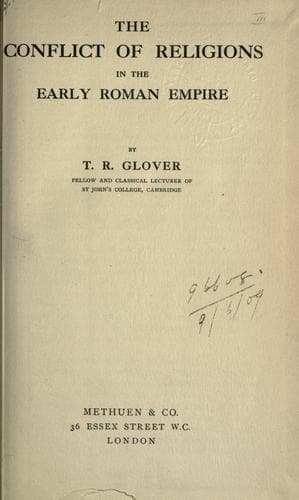
The Conflict of Religions in the Early Roman EmpireGlover, T. R. (Terrot Reaveley)
Religion
The Conflict of Religions in the Early Roman Empire
Glover, T. R. (Terrot Reaveley)
Christianity and other religions; Church history -- Primitive and early church, ca. 30-600; Rome -- Religion
But, after all, the force of the Christian movement lay neither in
church, nor in sacrament, but in men. "How did Christianity rise and
spread among men?" asks Carlyle, "was it by institutions, and
establishments, and well arranged systems of mechanism? No! ... It
arose in the mystic deeps of man's soul; and was spread by the
'preaching of the word,' by simple, altogether natural and individual
efforts; and flew, like hallowed fire, from heart to heart, till all
were purified and illuminated by it. Here was no Mechanism; man's
highest attainment was accomplished Dynamically, not Mechanically."[51]
Nothing could be more just. The Gospel set fire to men's hearts, and
they needed to do nothing but live to spread their faith. The ancient
evidence is abundant for this. The Christian had an "insatiable
passion for doing good"[52]--not as yet a technical term--and he "did
good" in the simplest kind of ways. "Even those things which you do
after the flesh are spiritual," says Ignatius himself, "for you do all
things in Jesus Christ."[53] "Christians," says a writer whose name is
lost, "are not distinguishable from the rest of mankind in land or
speech or customs. They inhabit no special cities of their own, nor do
they use any different form of speech, nor do they cultivate any
out-of-the-way life.... But while they live in Greek and barbarian
cities as their lot may be {160} cast, and follow local customs in
dress and food and life generally, ... yet they live in their own
countries as sojourners only; they take part in everything as citizens
and submit to everything as strangers. Every strange land is native to
them, and every native land is strange. They marry and have children
like everyone else--but they do not expose their children. They have
meals in common, but not wives. They are in the flesh, but they do not
live after the flesh. They continue on earth, but their citizenship is
in heaven. They obey the laws ordained, and by their private lives
they overcome the laws.... In a word, what the soul is in the body,
that is what Christians are in the world."[54]
Public-domain text, read in full here on John Shaqi.
Reviews
Reviews
No reviews yet
Be the first to share your thoughts on this work.
Elsewhere in the archive
Join the Discussion
Join the discussion
Sign in to leave a comment or review.
Sign InorCreate an account