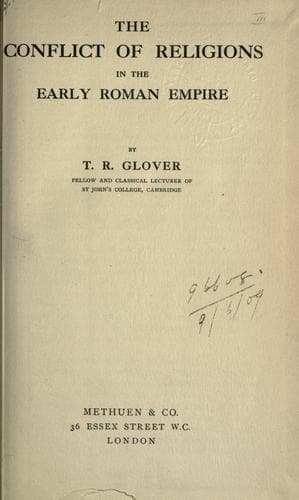
The Conflict of Religions in the Early Roman EmpireGlover, T. R. (Terrot Reaveley)
Religion
The Conflict of Religions in the Early Roman Empire
Glover, T. R. (Terrot Reaveley)
Christianity and other religions; Church history -- Primitive and early church, ca. 30-600; Rome -- Religion
"As a rule," wrote Galen, "men need to be educated in parables. Just
as in our day we see those who are called Christians[55] have gained
their faith from parables. Yet they sometimes act exactly as true
philosophers would. That they despise death is a fact we all have
before our eyes; and by some impulse of modesty they abstain from
sexual intercourse--some among them, men and women, have done so all
their lives. And some, in ruling and controlling themselves, and in
their keen passion for virtue, have gone so far that real philosophers
could not excel them."[56] So wrote a great heathen, and Celsus admits
as much himself. In life at least, if not in theory, the Christians
daily kept to the teaching of their Master. "Which is ampler?" asks
Tertullian, "to say, Thou shalt not kill; or to teach, Be not even
angry? Which is more perfect, to forbid adultery or to bid refrain
from a single lustful look?"[57] There was as yet no flight from the
world, though Christians had no illusions about it or about the devil
who played so large a part in its affairs. They lived in an age that
saw Antinous deified.[58] They stood for marriage and family life,
while all around "holy" men felt there was an unclean and daemonic
element in marriage.[59] One Christian writer even speaks of women
being {161} saved by child-bearing.[60] Social conditions they
accepted--even slavery among them--but they brought a new spirit into
all; love and the sense of brotherhood could transform every thing.
Slavery continued, but the word "slave" is not found in Christian
catacombs.[61]
Above all, they were filled with their Master's own desire to save men.
"I am debtor," wrote Paul, "both to Greeks and to barbarians, wise and
unwise."[62] If modern criticism is right in detaching the "missionary
commission" (in Matthew) from the words of Jesus, the fact remains that
the early Christians were "going into all the world" and "preaching the
gospel to every creature" for half a century before the words were
written. Why? "He that has the word of Jesus truly can hear his
silence," said Ignatius; and if Jesus did not speak these words, men
heard his silence to the same effect. Celsus, like Julian long after
him, was shocked at the kind of people to whom the gospel was
preached.[63]
Public-domain text, read in full here on John Shaqi.
Reviews
Reviews
No reviews yet
Be the first to share your thoughts on this work.
Elsewhere in the archive
Join the Discussion
Join the discussion
Sign in to leave a comment or review.
Sign InorCreate an account