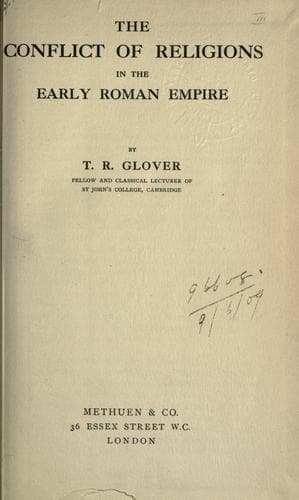
The Conflict of Religions in the Early Roman EmpireGlover, T. R. (Terrot Reaveley)
Religion
The Conflict of Religions in the Early Roman Empire
Glover, T. R. (Terrot Reaveley)
Christianity and other religions; Church history -- Primitive and early church, ca. 30-600; Rome -- Religion
God and immortality were associated in Christian thought. Christians,
said a writer using the name of Peter, are to be "partakers of the
divine nature." "If the soul," says Tatian, "enters into union with
the divine spirit, it is no longer helpless, but ascends to regions
whither the spirit guides it; for the dwelling-place of the spirit is
above, but the origin of the soul is from beneath."[68] "God sent
forth to us the Saviour and Prince of immortality, by whom he also made
manifest to us the truth and the heavenly life."[69] The Christian's
life is "hid with Christ in God," and Christ's resurrection is to the
{164} early church the pledge of immortality--"we shall be ever with
the Lord." For the transmigration of souls and "eternal re-dying,"
life was substituted.[70] "We have believed," said Tatian, "that there
will be a resurrection of our bodies, after the consummation of all
things--not, as the Stoics dogmatize, that in periodic cycles the same
things for ever come into being and pass out of it for no good
whatever,--but once for all," and this for judgment. The judge is not
Minos nor Rhadamanthus, but "God the maker is the arbiter."[71] "They
shall see him (Jesus) then on that day," wrote the so-called Barnabas,
"wearing the long scarlet robe upon his flesh, and they will say 'Is
this not he whom we crucified, whom we spat upon, and rejected?'"[72]
Persecution tempted the thought of what "that day" would mean for the
persecutor. But it was a real concern of the Christian himself. "I
myself, utterly sinful, not yet escaped from temptation, but still in
the midst of the devil's engines,--I do my diligence to follow after
righteousness that I may prevail so far as at least to come near it,
fearing the judgment that is to come."[73] Immortality and
righteousness--the two thoughts go together, and both depend upon Jesus
Christ. He is emphatically called "our Hope"--a favourite phrase with
Ignatius.[74]
[Sidenote: Martyrdom and happiness]
Public-domain text, read in full here on John Shaqi.
Reviews
Reviews
No reviews yet
Be the first to share your thoughts on this work.
Elsewhere in the archive
Join the Discussion
Join the discussion
Sign in to leave a comment or review.
Sign InorCreate an account