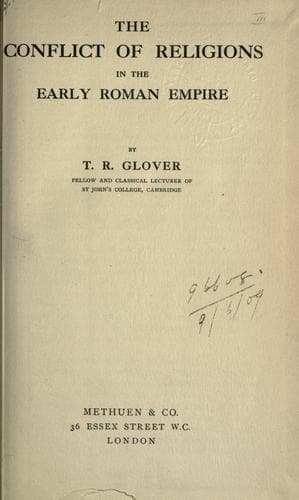
The Conflict of Religions in the Early Roman EmpireGlover, T. R. (Terrot Reaveley)
Religion
The Conflict of Religions in the Early Roman Empire
Glover, T. R. (Terrot Reaveley)
Christianity and other religions; Church history -- Primitive and early church, ca. 30-600; Rome -- Religion
It was not Stoic cosmopolitanism. The Christian was not "the citizen
of the world" nor "the Friend of Man"; he was a plain person who gave
himself up for other people, cared for the sick and the worthless, had
a word of friendship and hope for the sinful and despised, would not go
and see men killed in the amphitheatre, and--most curious of all--was
careful to have indigent brothers taught trades by which they could
help themselves. A lazy Christian was no Christian, he was a "trader
in Christ."[64] If the Christians' citizenship was in heaven, he had a
social message for this world in the meantime.
[Sidenote: Woman]
Every great religious movement coincides with a new discovery of truth
of some kind, and such discoveries induce a new temper. Men inquire
more freely and speak more freely the truth they feel. Mistakes are
made and a movement begins {163} for "quenching the spirit." But the
gains that have been made by the liberated spirits are not lost. Thus
the early Christian rose quickly to a sense of the value of woman. Dr
Verrall pronounces that "the radical disease, of which, more than of
anything else, ancient civilization perished "was" an imperfect ideal
of woman."[65] In the early church woman did a good many things, which
in later days the authorities preferred not to mention. Thekla's name
is prominent in early story, and the prophetesses of Phrygia, Prisca
and Maximilla, have a place in Church History. They were not popular;
but the church was committed to the Gospel of Luke and the ministry of
women to the Lord. And whatever the Christian priesthood did or said,
Jesus and his followers had set woman on a level with man. "There is
neither male nor female." The same freedom of spirit is attested by
the way in which pagan prophets and their dupes classed Christians with
Epicureans[66]--they saw and understood too much. The Christians were
the only people (apart from the Jews) who openly denounced the folly of
worshipping and deifying Emperors. Even Ignatius, who is most famous
for his belief in authority, breaks into independence when men try to
make the Gospel dependent on the Old Testament--"for me the documents
(_ta archeia_) are Jesus Christ; my unassailable documents are his
cross, and his death and resurrection, and the faith that is through
him; in which things I hope with your prayers to be saved."[67] "Where
the spirit of the Lord is, there is liberty," as Paul said.
Public-domain text, read in full here on John Shaqi.
Reviews
Reviews
No reviews yet
Be the first to share your thoughts on this work.
Elsewhere in the archive
Join the Discussion
Join the discussion
Sign in to leave a comment or review.
Sign InorCreate an account