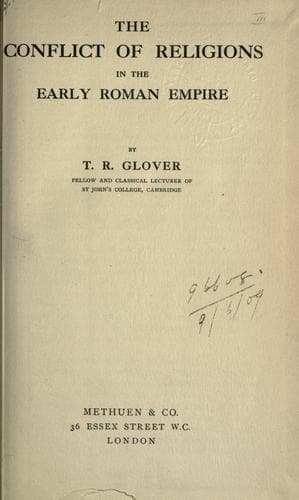
The Conflict of Religions in the Early Roman EmpireGlover, T. R. (Terrot Reaveley)
Religion
The Conflict of Religions in the Early Roman Empire
Glover, T. R. (Terrot Reaveley)
Christianity and other religions; Church history -- Primitive and early church, ca. 30-600; Rome -- Religion
[43] See a very interesting chapter in Philo's _de migr. Abr._ 7 (441
M), where he gives a very frequent experience of his own (_muriakis
pathon_) as a writer. Sometimes, though he "saw clearly" what to say,
he found his mind "barren and sterile" and went away with nothing done,
with "the womb of his soul closed." At other times he "came empty and
suddenly became full, as thoughts were imperceptibly sowed and snowed
upon him from above, so that, as if under Divine possession (_katoches
entheou_), he became frenzied (_korubantian_) and utterly knew not the
place, nor those present, nor himself, nor what was said or written."
See Tert. _de Anima_, 11, on the spirits of God and of the devil that
may come upon the soul.
[44] It may be remarked, in passing, that the contemporary worship of
the Emperor is to be explained by the same theory of the possibility of
an indwelling daimonion. It was helped out by the practice, which had
never so far died out in the East and in Egypt, of regarding the King
and his children as gods incarnate. See J. G. Frazer, _Early History
of Kingship_.
[45] Tertullian, _adv._ Marc, iii, 8, _nihil solidam ab inani, nihil
plenum a vacuo perfici licuit ... imaginarius operator, imaginariae
operae_.
[46] Tertullian, _de carne Christi_, 5.
[47] His Tarsiot feeling is perhaps shown by his preference that women
should be veiled. Dio Chrysostom (_Or._ 33, 48) mentions that in
Tarsus there is much conservatism shown in the very close veiling of
the women's faces.
[48] Tert. _Apol._ 39, _Corpus sumus de conscientia religionis et
disciplinae unitate et spei foedere_.
[49] Ign. _Eph._ 20; Clem. Alex. _Protr._ 106.
[50] Justin, _Apol._ i, 66, the use of bread and cup in the mysteries
of Mithras; Tertullian, _de Bapt._ 5, on baptism in the rites of Isis
and Mithras, the mysteries of Eleusis, etc.
[51] Carlyle, _Signs of the Times_, (Centenary edition of Essays, ii,
p. 70.)
[52] Clem. R. 2, 2, _akorestos pothos eis agathopoiian_.
[53] Ign. _Eph._ 8, 2.
[54] Auctor _ad Diognetum_, 5-6.
[55] He apologizes for the use of the name, as educated people did in
his day, when it was awkward or impossible to avoid using it. It was a
vulgarism.
[56] Galen, extant in Arabic in _hist. anteislam_. _Abulfedae_ (ed.
Fleischer, p. 109), quoted by Harnack, _Expansion of Christianity_, i,
p. 266.
[57] Tertullian, _Apol._ 45; cf. Justin, _Apol._ i, 15.
[58] Cf. Justin, _Apol._ i, 29.
[59] The feeling referred to is associated with the primitive sense of
the mystery of procreation and conception surviving, it is said, among
the Arunta of Australia, and very widely in the case of twins; see
Rendel Harris, _Cult of the Dioscuri_.
[60] Tim. 2, 15. Cf. Tert. _adv. Marc._ iv, 17, _nihil impudentius si
ille nos sibi filio faciet qui nobis filios facere non permisit
aufercndo conubium_.
[61] de Rossi, cited by Harnack, _Expansion_, i, 208 n.
[62] Romans 1, 14.
[63] See p. 241; and cf. Justin, _Apol._ i, 15.
Public-domain text, read in full here on John Shaqi.
Reviews
Reviews
No reviews yet
Be the first to share your thoughts on this work.
Elsewhere in the archive
Join the Discussion
Join the discussion
Sign in to leave a comment or review.
Sign InorCreate an account