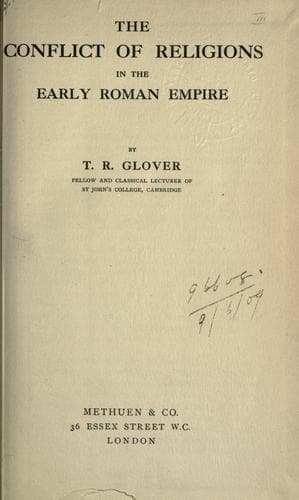
The Conflict of Religions in the Early Roman EmpireGlover, T. R. (Terrot Reaveley)
Religion
The Conflict of Religions in the Early Roman Empire
Glover, T. R. (Terrot Reaveley)
Christianity and other religions; Church history -- Primitive and early church, ca. 30-600; Rome -- Religion
That part of the Jewish race, and it was the larger part, which did not
accept the new religion, was in no mind to admit either Paul's
premisses or his conclusions. They stood for God's covenant with
Israel. Nor did they stand alone, for it took time to convince even
Christian Jews that the old dispensation had yielded to a new one, and
that the day of Moses was past. To the one class the rise of the
Christian community was a menace, to the other a problem. The one left
no means untried to check it. By argument, by appeals to the past, by
working on his superstitions, they sought to make the Christian convert
into a Jew; and, when they failed, they had other methods in reserve.
Themselves everywhere despised and hated, as they are still, for their
ability and their foreign air, they stirred up their heathen neighbours
against the new race. Again and again, in the _Acts_ and in later
documents, we read of the Jews being the authors of pagan
persecution.[1] The "unbelieving Jew" was a spiritual and a social
danger to the Christian in every city of the East. The converted Jew
was, in his way, almost as great a difficulty within the community.
It is not hard to understand the feeling of the Jews within or without
the Church. Other races had their ancient histories, and the Jew had
his--a history long and peculiar. From the day of Abraham, the friend
of God, the chosen race had been the special care of Jehovah. Jehovah
had watched over them; he had saved them from their enemies; he had
visited them for their iniquities; he had sent them prophets; he had
given them his law. In a long series of beautiful images, which move
us yet, Jehovah had spoken, through holy men of old, of his love for
Israel. To Israel belonged the oracles of God {170} and his promises.
For here again the national consciousness of Israel differed from that
of every other race. It was something that in the past God had spoken
to no human family except the seed of Abraham; it was more that to
them, and to them alone, he had assured the future. Deeply as Israel
felt the trials of the present, the Roman would yet follow the Persian
and the Greek, and the day of Israel would dawn. The Messiah was to
come and restore all things.
"He shall destroy the ungodly nations with the word of his mouth, so
that at his rebuke the nations may flee before him, and he shall
convict the sinners in the thoughts of their hearts.
"And he shall gather together a holy people whom he shall lead in
righteousness; and shall judge the tribes of his people that hath been
sanctified by the Lord his God.
"And he shall not suffer iniquity to lodge in their midst, and none
that knoweth wickedness shall dwell with them....
"And he shall possess the nations of the heathen to serve him beneath
his yoke; and he shall glorify the Lord in a place to be seen of the
whole earth;
"And he shall purge Jerusalem and make it holy, even as it was in the
days of old.
Public-domain text, read in full here on John Shaqi.
Reviews
Reviews
No reviews yet
Be the first to share your thoughts on this work.
Elsewhere in the archive
Join the Discussion
Join the discussion
Sign in to leave a comment or review.
Sign InorCreate an account