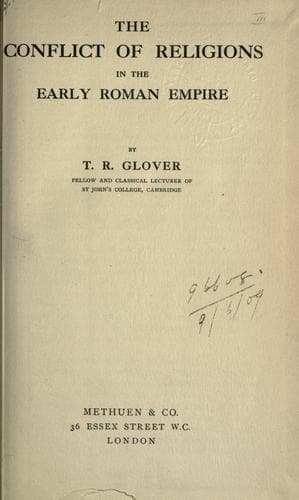
The Conflict of Religions in the Early Roman EmpireGlover, T. R. (Terrot Reaveley)
Religion
The Conflict of Religions in the Early Roman Empire
Glover, T. R. (Terrot Reaveley)
Christianity and other religions; Church history -- Primitive and early church, ca. 30-600; Rome -- Religion
There is no doubt that the hostile Jews very quickly realised Paul's
significance, but the Christians were not so quick. Paul was a
newcomer and very much the ablest man among them--they were "not many
wise, not many learned," and Paul, though he does not mention it, was
both. He was moreover proposing to take them into regions far beyond
their range; he had not personally known "the Lord" and they had; and
there was no clear word of Jesus on the Gentile question. There was a
conference. What took place, Paul tries in the Galatians to tell; but
he is far too quick a thinker to be a master of mere narrative; the
question of Christian freedom was too hot in his heart to leave him
free for reminiscence, and the matter is not very clear. The author of
the Acts was not at the council, and, whatever his authorities may have
been, there is a constant suggestion in his writing that he has a
purpose in view--a purpose of peace between parties. Whether they
liked the result or not, the Christian community seem loyally to have
submitted themselves to "the Spirit of Jesus." "It seemed good to the
holy spirit and to us" tells the story of their deliberations, whether
they put the phrase at the top of a resolution or did not. Paul came
to the personal followers of Jesus with a new and strange conception of
the religion of their Master. They laid it alongside of their memories
of their Master, and they heard him say "Go ye into all the world"; and
they went.
The natural outcome of this forward step at once became evident. Paul
did not go among the Gentiles to "preach circumcision," and there
quickly came into being, throughout Asia Minor and in the Balkan
provinces, many groups of Christians of a new type--Gentile in mind and
tradition, and in Christian life no less Gentile. They remained
uncircumcised, they did not observe the Sabbath nor any other
distinctive usage of Judaism--they were a new people, a "third race."
Their very existence put Judaism on the defensive; for, if their
position was justified, it was hard to see {169} what right Judaism had
to be. It was not yet quite clear what exactly the new religion was,
nor into what it might develope; but if, as the Gentile Christians and
their Apostle claimed, they stood in a new relation to God, a higher
and a more tender than the greatest and best spirits in Israel had
known, and this without the seal of God's covenant with Israel and
independently of his law, then it was evident that the unique
privileges of Israel were void, and that, as Paul put it, "there is
neither Jew nor Greek."
Public-domain text, read in full here on John Shaqi.
Reviews
Reviews
No reviews yet
Be the first to share your thoughts on this work.
Elsewhere in the archive
Join the Discussion
Join the discussion
Sign in to leave a comment or review.
Sign InorCreate an account