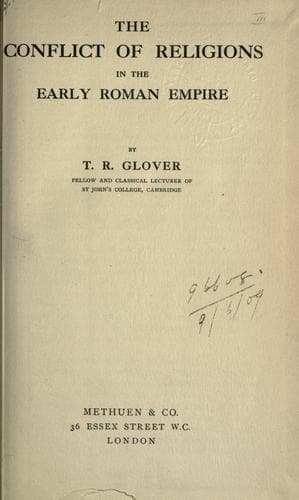
The Conflict of Religions in the Early Roman EmpireGlover, T. R. (Terrot Reaveley)
Religion
The Conflict of Religions in the Early Roman Empire
Glover, T. R. (Terrot Reaveley)
Christianity and other religions; Church history -- Primitive and early church, ca. 30-600; Rome -- Religion
But this was not all. Israel had stood for monotheism and that not the
monotheism of Greek philosophy, a dogma of the schools consistent with
the cults of Egypt and Phrygia, with hierodules and a deified Antinous.
The whole nation had been consecrated to the worship of One God, a
personal God, who had, at least where Israel was concerned, no hint of
philosophic Apathy. The Jew was now asked by the Christian to admit a
second God--a God beside the Creator (_allos theos para ton poieten ton
holon_[5])--and such a God! The Jews knew all about Jesus of
Nazareth--it was absurd to try to pass him off even as the Messiah.
"Sir," said Trypho, "these scriptures compel us to expect one glorious
and great, who receives from 'the Ancient of Days' the 'eternal
Kingdom' as 'Son of Man'; but this man of yours--your so-called
Christ--was unhonoured and inglorious, so that he actually fell under
the extreme curse that is in the law of God; for he was crucified."[6]
The whole thing was a paradox, incapable of proof.[7] "It is an
incredible thing, and almost impossible that you are trying to
prove--that God endured to be begotten and to become a man."[8]
The Jews had a propaganda of their own about Jesus. They sent
emissaries from Palestine to supply their countrymen and pagans with
the truth.[9] Celsus imagines a Jew disputing with a Christian,--a
more life-like Jew, according to Harnack, than Christian apologists
draw,--and the arguments he uses came from Jewish sources. Jesus was
born, they said, in a village, the bastard child of a peasant woman, a
poor person who worked with her hands, divorced by her husband (who was
a carpenter) for adultery.[10] The father was a soldier called
Panthera. As to the Christian story, what could have attracted the
attention of God to her? Was she pretty? The carpenter at all events
hated her and cast her out.[11] {173} ("I do not think I need trouble
about this argument," is all Origen says.) Who saw the dove, or heard
the voice from heaven, at the baptism? Jesus suffered death in
Palestine for the guilt he had committed (_plemmelesanta_). He
convinced no one while he lived; even his disciples betrayed him--a
thing even brigands would not have done by their chief--so far was he
from improving them, and so little ground is there for saying that he
foretold to them what he should surfer. He even complained of thirst
on the cross. As for the resurrection, that rests on the evidence of a
mad woman (_paroistros_)--or some other such person among the same set
of deceivers, dreaming, or deluded, or "wishing to startle the rest
with the miracle, and by a lie of that kind to give other impostors a
lead." Does the resurrection of Jesus at all differ from those of
Pythagoras or Zamolxis or Orpheus or Herakles--"or do you think that
the tales of other men both are and seem myths, but that the
catastrophe of your play is a well-managed and plausible piece of
Public-domain text, read in full here on John Shaqi.
Reviews
Reviews
No reviews yet
Be the first to share your thoughts on this work.
Elsewhere in the archive
Join the Discussion
Join the discussion
Sign in to leave a comment or review.
Sign InorCreate an account