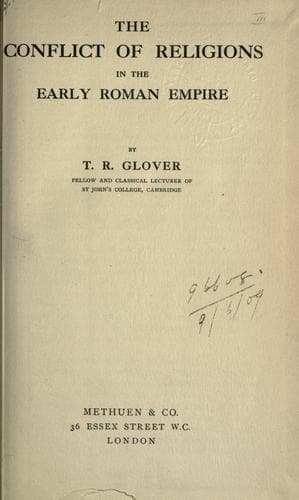
The Conflict of Religions in the Early Roman EmpireGlover, T. R. (Terrot Reaveley)
Religion
The Conflict of Religions in the Early Roman Empire
Glover, T. R. (Terrot Reaveley)
Christianity and other religions; Church history -- Primitive and early church, ca. 30-600; Rome -- Religion
invention--the cry upon the gibbet, when he died, and the earthquake
and the darkness?"[12] The Christians systematically edited and
altered the Gospels to meet the needs of the moment;[13] but Jesus did
not fulfil the prophecies of the Messiah--"the prophets say he shall be
great, a dynast, lord of all the earth and all its nations and
armies."[14] There are ten thousand other men to whom the prophecies
are more applicable than to Jesus,[15] and as many who in frenzy claim
to "come from God."[16] In short the whole story of the Christians
rests on no evidence that will stand investigation.
Even men who would refrain from the hot-tempered method of controversy,
which these quotations reflect, might well feel the contrast between
the historic Jesus and the expected Messiah--between the proved failure
of the cross and the world-empire of a purified and glorious Israel.
And when it was suggested further that Jesus was God, an effluence
coming from God, as light is lit by light--even if this were true, it
would seem that the Jew was asked to give up the worship of the One
God, which he had learnt of his fathers, and to turn to a being not
unlike the pagan gods around him in every land, who also, their
apologists said, came from the {174} Supreme, and were his emanations
and ministers and might therefore be worshipped.
Thus everything that was distinctive of their race and their
religion--the past of Israel, the Messiah and the glorious future, the
beautiful symbols of family religion, and the One God Himself--all was
to be surrendered by the man who became a Christian. We realize the
extraordinary and compelling force of the new religion, when we
remember that, in spite of all to hold them back, there were those who
made the surrender and "suffered the loss of all things to win Christ
and be found in him." Paul however rested, as he said, on revelation,
and ordinary men, who were not conscious of any such distinction, who
mistrusted themselves and their emotions, and who rested most naturally
upon the cumulative religious experience of their race, might well ask
whether after all they were right in breaking with a sacred
past--whether, apart from subjective grounds, there were any clear
warrant from outside to enable them to go forward. The Jew had of
course oracles of God given by inspiration (_theopneustos_[17]),
written by "holy men of God, moved by the holy spirit." These were his
warrant. Here circumcision, the Sabbath, the Passover, and all his
religious life was definitely and minutely prescribed in what was
almost, like the original two tables, the autograph of the One God.
The law had its own history bound up with that of the race, and the
experience and associations of every new generation made it more deeply
awful and mysterious. Had the Christian any law? had he any oracles,
apart from the unintelligible glossolalies of men possessed
(_enthousiontes_)? When Justin spoke of the gifts of the Spirit,
Public-domain text, read in full here on John Shaqi.
Reviews
Reviews
No reviews yet
Be the first to share your thoughts on this work.
Elsewhere in the archive
Join the Discussion
Join the discussion
Sign in to leave a comment or review.
Sign InorCreate an account